

The growing concentration of attention
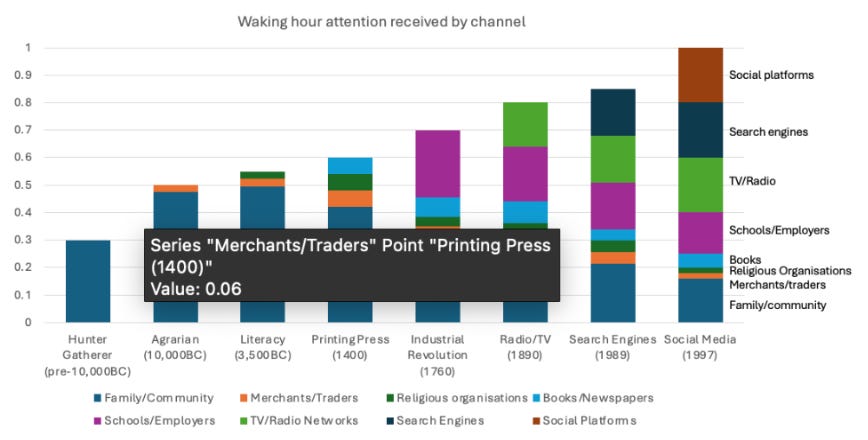
Early on, most interaction was real-life interaction in families, communities, religion or for trade.
However, over time, online intermediaries have been able to command larger amounts of distribution than other forms of interaction, as they have:
Access to large swathes of novel content that individuals would otherwise less easily be able to access
The ability to effectively parse through these large swathes of content and show people the content they would find most relevant
For centuries, fictional stories captured a large amount of attention; then books enabled greater distribution; soon after newspapers were able to constantly supply a batch of engaging novel information to the people, before radio and then television distributed content across an even more engaging medium.
Access to large distribution enabled content distributors like newspapers, radio, and TV channels to invest in creating even more engaging content that would be viewed by millions - as it was better than most existing alternatives for timepass. These would be funded by communal funding (taxes or fees) or advertisements - so to say that the ability to invest in creating or curating this content meant that the final result was so much better than alternatives that humans paid for it with money or time.
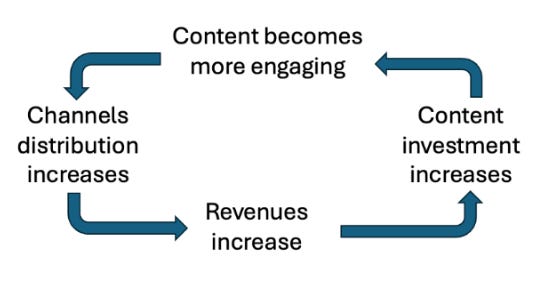
As production costs decreased, this content became more personalised, so the quantity of newspapers increased, and more TV and radio channels were created - with content tailored to specific audiences. This made it even more engaging.
Social media changed the game entirely, cutting platform content costs to virtually 0 so that intermediaries like Facebook, Instagram, Snapchat and Tik Tok can access even larger swathes of data and distribute it in an even more bespoke manner.
In doing so, social platforms have managed to capture an increasing share of attention, to the point now where 1 in 3 minutes of mobile phone use is on social media, and 16-24 year old girls spend on average 3 hours per day on social media.
Those channels that capture large amounts of attention have an extra impact from their influence on other existing channels
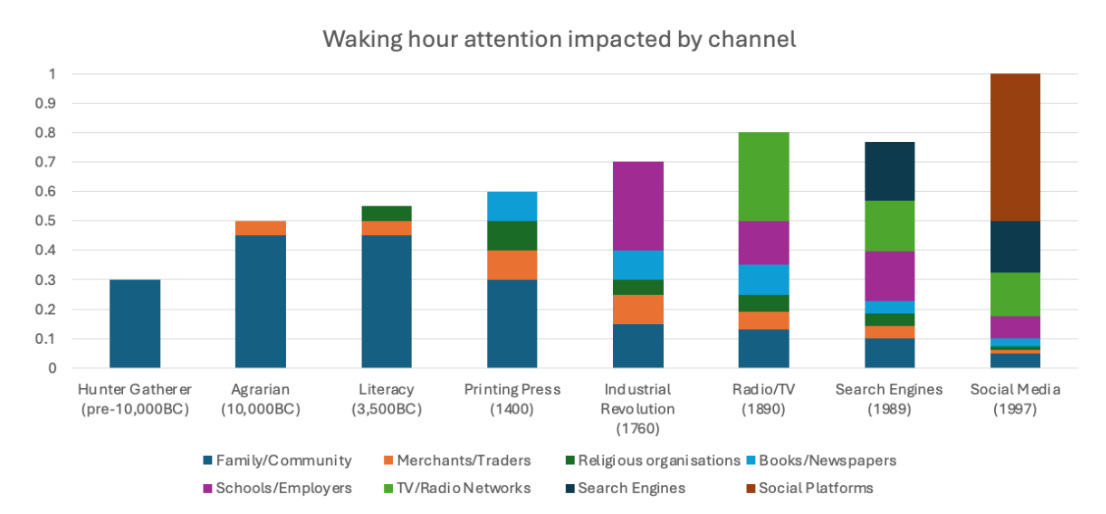
If we look at how much impact new channels have on the content that captures human attention, rather than just the direct attention these new channels receive, new channels have an even larger concentration of attention, as they affect all other existing channels. Each new technology trend has an informational impact on prior channels.
Take social media:
Large swathes of content uploaded to social media mean that it has a large sway on search engine trends.
Access that social media has to audiences means that TV is also increasingly becoming designed for social - to ensure that it can get viewers. People often watch TV with 2 screens.
Similarly, the fact that the majority of your friends are also highly informed by social media means that its informational value and impact on what your family and community pay attention to is incredibly high - this gives it even more influence on your beliefs, emotions and actions.
As such, powers are becoming increasingly concentrated in new channels.