

PART 1: The Core Strategy & Foundation
LinkedIn is filled with corporate content that most people ignore. To stand out, we must focus on building strong personal profiles, not relying on a company page.
Focus on People, Not Logos: Use founder and team member accounts as your main content channels. Talk about stories, lessons, wins, failures, and expertise.
Centralized Oversight: A dedicated manager must oversee content for at least four team members (including the CEO) to keep messaging aligned and consistent.
Focus on total profile reach and impressions across all team members. Avoid vanity metrics like individual post likes.
To keep the profile high-signal, implement a schedule to remove underperforming content. Any post that has not received meaningful engagement (save, share, comment) in the last 90 days should be removed from the Featured section.
Profile Optimization: The Ultimate Sales Asset
Your profile must serve as a high-converting landing page that establishes trust immediately.
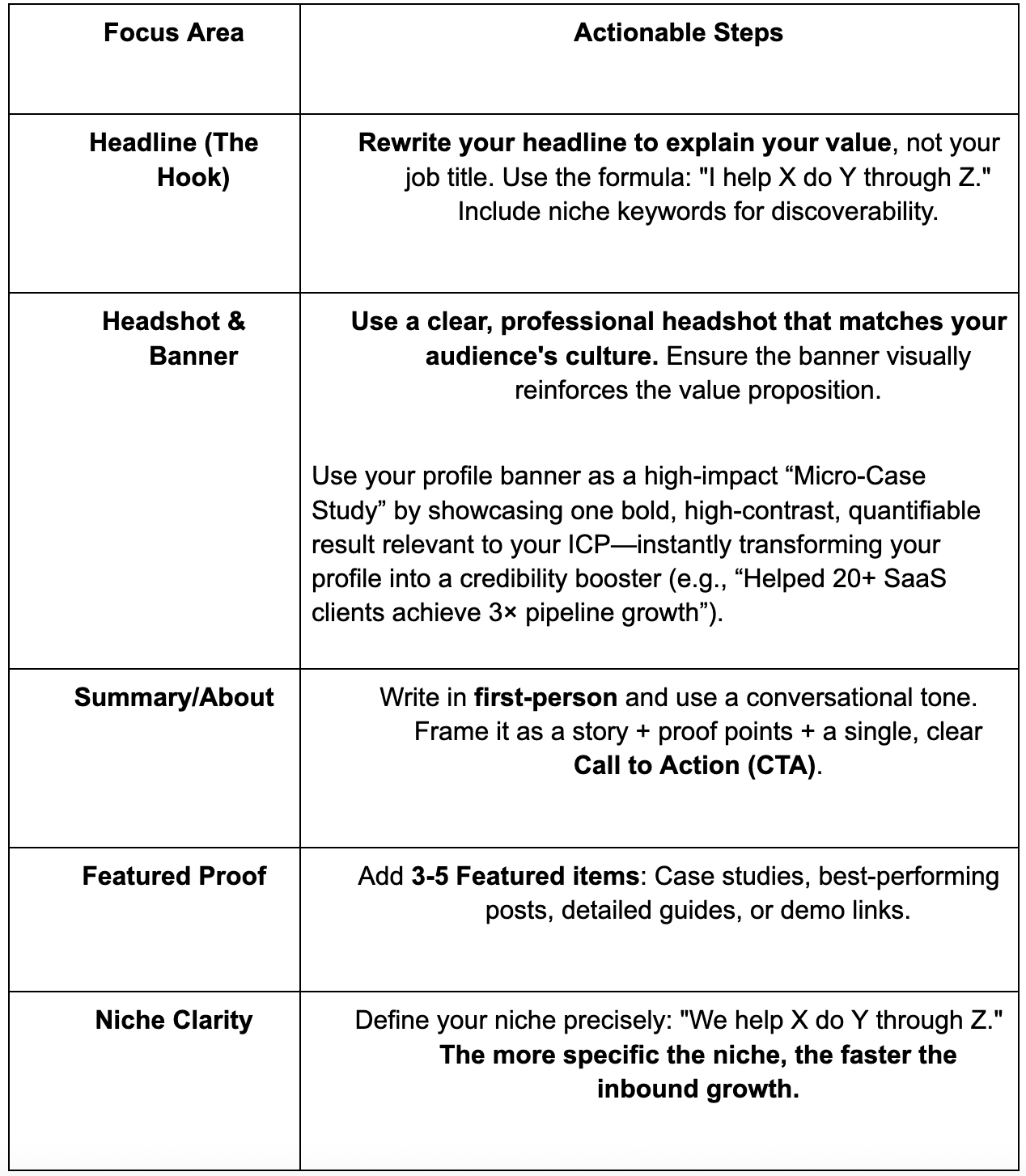
Use your profile banner as a high-impact “Micro-Case Study” by showcasing one bold, high-contrast, quantifiable result relevant to your ICP—instantly transforming your profile into a credibility booster (e.g., “Helped 20+ SaaS clients achieve 3× pipeline growth”).
Summary/About
Write in first-person and use a conversational tone. Frame it as a story + proof points + a single, clear Call to Action (CTA).
Featured Proof
Add 3-5 Featured items: Case studies, best-performing posts, detailed guides, or demo links.
Niche Clarity
Define your niche precisely: “We help X do Y through Z.” The more specific the niche, the faster the inbound growth.
PART 2: Content System & Engagement
A weekly content habit is the engine of distribution. It compounds visibility, reach, and inbound engagement.
Posting Cadence: 3 high-quality posts/week per profile. Focus on content that drives utility:
Stories and personal lessons learned.
Frameworks, workflows, and “How-to” guides.
Case studies and data-driven insights.
Content Pillars: Choose 3–5 pillars to maintain focus (e.g., Industry insights, Tactical workflows, Mistakes & warnings).
Content Mining: Use tools like Answer the Public and analyze niche subreddit/YouTube trends to find high-demand topics that inform your writing.
Timing Optimization: The optimal time to post depends on the role of the target audience, not just their industry.
Senior Executives (C-suite): Target commute times (7-8 AM or 5-7 PM local time).
Individual Contributors (Managers/Analysts): Target midday lulls (11 AM - 2 PM local time).
High-Performance Content Principles
The goal is to drive the “See More” click and encourage comments.
Format for Skimmability: Use punchy first lines and break up text.
Systematically use Carousels (excellent for processes), short videos, polls, and screenshot breakdowns.
End every post with a thoughtful question to encourage comments, then respond to all comments.
Adjust your content’s angle based on the primary target region for the profile:
APAC (Asia-Pacific): Prioritize data-driven insights and case studies.
EMEA (Europe): Focus on strong personal opinion and thought leadership.
LATAM (Latin America): Use collaborative posts and discussion prompts to drive networking.
Engagement & Distribution Loops (The Amplification Loop)
Thoughtful engagement (micro-posting) often drives more profile views than your own main posts, boosting all subsequent outreach results.
Daily Commenting (10–25 min): Leave thoughtful comments on prospects’ and peers’ content.
Post-Posting Window (60 Minutes): After a profile posts, the manager must immediately:
Reply to initial comments quickly.
Comment on 5 - 10 niche posts to keep the profile active.
Team Amplification: Encourage employees to comment on each other’s posts and re-share insightfully.
Feed Curation & Groups: Remove noise. Keep your feed targeted to prospects and relevant industry peers.
Join 3 strong groups and post daily insights there, as groups often offer underserved organic reach.
To effectively build trust and maintain authority, implement a 4:1 content ratio where four out of five posts offer high-value utility (frameworks, guides), and one post is a vulnerable personal story (failure, lesson). This strategy humanizes the author and makes the actionable, utility content more believable and authoritative to the audience.
Tips & Tricks:
To achieve high post distribution safely, avoid risky external engagement pods and instead utilize a structured Internal Team Engagement Channel (like Slack or Teams).
When a key team member posts, the content manager sends the direct link to the channel with a precise Call to Action: “Comment (3+ sentences of value) + Save.”
The Key Insight: Requiring the “Save” action is crucial. It signals high utility to the LinkedIn algorithm, significantly boosting the post’s organic distribution and lifespan.
The Strategic Repost as a New Post
Direct reposting is ineffective. Instead, a successful post can be given a “second life” by slightly modifying it.
Insight: If a post performs exceptionally well, wait 4–6 weeks, copy the core content, and execute two specific changes: change the first line (the hook) and use a slightly different content format (e.g., original was text, repost as a single image quote card).
Action: This bypasses the algorithm’s anti-repost filter, granting the content a “second life” and exposing it to a new segment of your audience who missed the original.
Micro-Community Activation via Polls
Polls should be used to isolate hyper-specific, high-pain audiences by making the options self-segmenting.
Insight: Structure the poll options to represent different stages or types of a pain point your solution addresses. For example, instead of “Yes/No,” options could be A) Lead Volume (Awareness pain), B) Conversion Rate (Mktg/Sales pain), C) Retention (Product/CS pain).
Action: Target your follow-up outreach only to those who select the answer corresponding to the problem your product solves best. This is instant, self-segmenting lead generation.
PART 3: The Outreach Execution System
Sales Navigator is Mandatory. It is the only way to build precise, manageable Tier 1 ICP lists.
Targeting Precision: Use Boolean search with advanced filters to build precise prospect lists.
Automated Alerts: Monitor for job or company changes.
Warm Paths: Leverage shared connections to create warm introduction paths.
Hyper-Personalized Outreach
The goal is to follow The Bananarama Syndrome: messages must feel like they were “Typed in 2 minutes while eating a bagel”—personal, believable, and devoid of marketing hype.
Connection Volume: Start at 20 requests/day and scale slowly up to 50/day to avoid LinkedIn flags.
The Drip Structure (Sell the Meeting, Not the Product):
Request: Casual, relevant connection request.
Thanks: Quick “Thanks for connecting” (No pitch).
Value Message: Share a helpful, non-promotional article or industry insight (ideally not ours).
Meeting CTA: Light, consultative ask framed around their challenges (The Consultative DM).
Pattern Interrupts: Use these to break through the noise for high-value targets:
Voice Notes (30–45 seconds): Boosts reply rates by 30–40% (best used for follow-ups).
Personalized Video (< 90 seconds): Screen-record their profile or site while your face appears in the corner. Always add subtitles.
The “Dark Post” Connection Request: Achieve a higher acceptance rate by leveraging recency bias in the personalized note. Instead of referencing their job, reference their recent activity, a comment they left on an influencer’s post, or a company announcement. This creates immediate, contextual relevance.
Lead Generation & Sales Mechanisms
These tactics ensure conversations are moved efficiently through the pipeline.
Consultative DM Message: Ask about their daily challenges and propose a value exchange (not a product pitch).
DM Spark: Move comment “sparks” (warm engagement) into deeper 1:1 DM conversations immediately.
Signal Tracking: If a prospect engages 3 times, connect and share a helpful post of yours. No pitch at first.
Inbound Assist: Use profile-visiting tools (e.g. Outreach) to automatically view prospect profiles, often shifting the dynamic by prompting them to connect first.
Word-of-Mouth Engine: Develop a systematic way to make customer sharing easy.
Targeting Prospects by Their Job Postings
Company job openings are a powerful indicator of strategic pain points and intent to spend.
Insight: Use Sales Navigator or alerts to find target companies currently hiring for roles that intersect with your solution (e.g., hiring a “RevOps Manager” indicates software purchase intent or a critical process gap).
Action: Reference the job posting in the initial outreach: “Saw you’re hiring a [Role]—that usually signals X challenge. We help teams with Y problem you’re likely facing right now. Connect?” This creates a high-relevance “Why Now” trigger.
PART 4: Execution & Growth
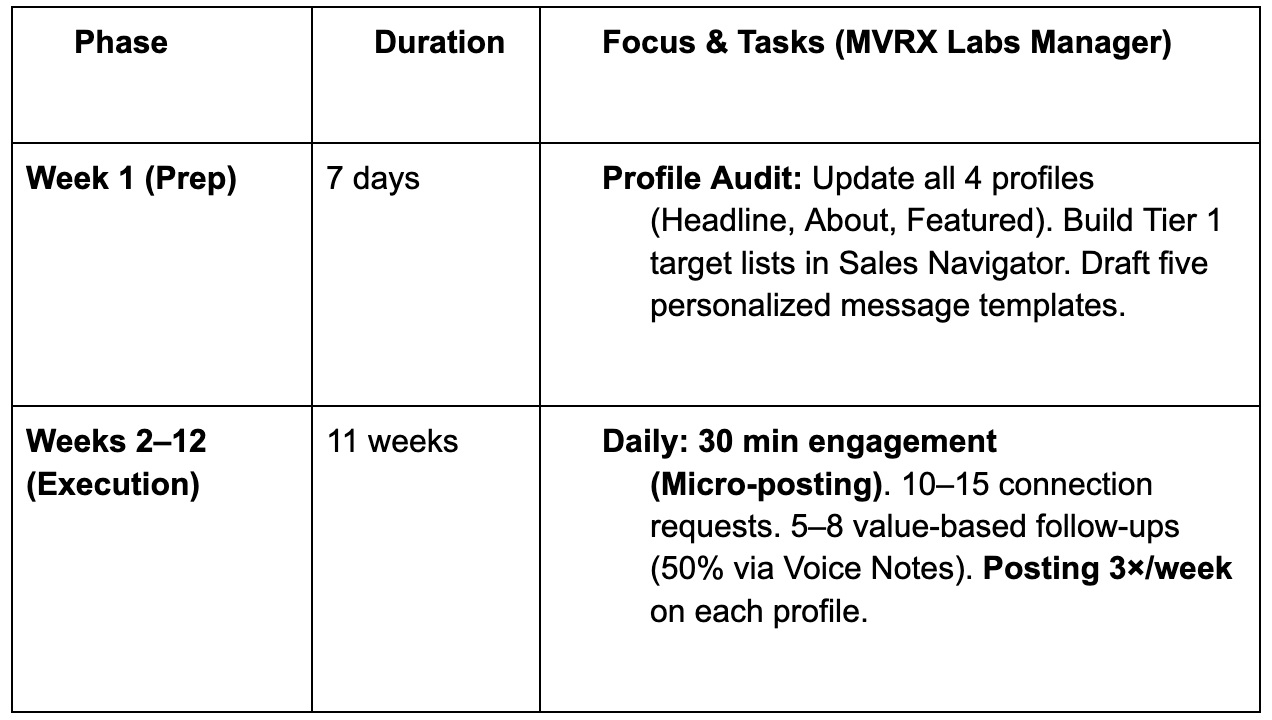
Action Plan (12 Weeks)
This plan focuses the MVRX Labs manager’s efforts for immediate impact.
Final Execution Rules
Choose 3 tactics and execute daily for 30 days without deviation.
Track follow-ups meticulously. Most deals die due to lack of follow-through.
Create a Plan of Action (POA) for prospects to simplify their next step.