

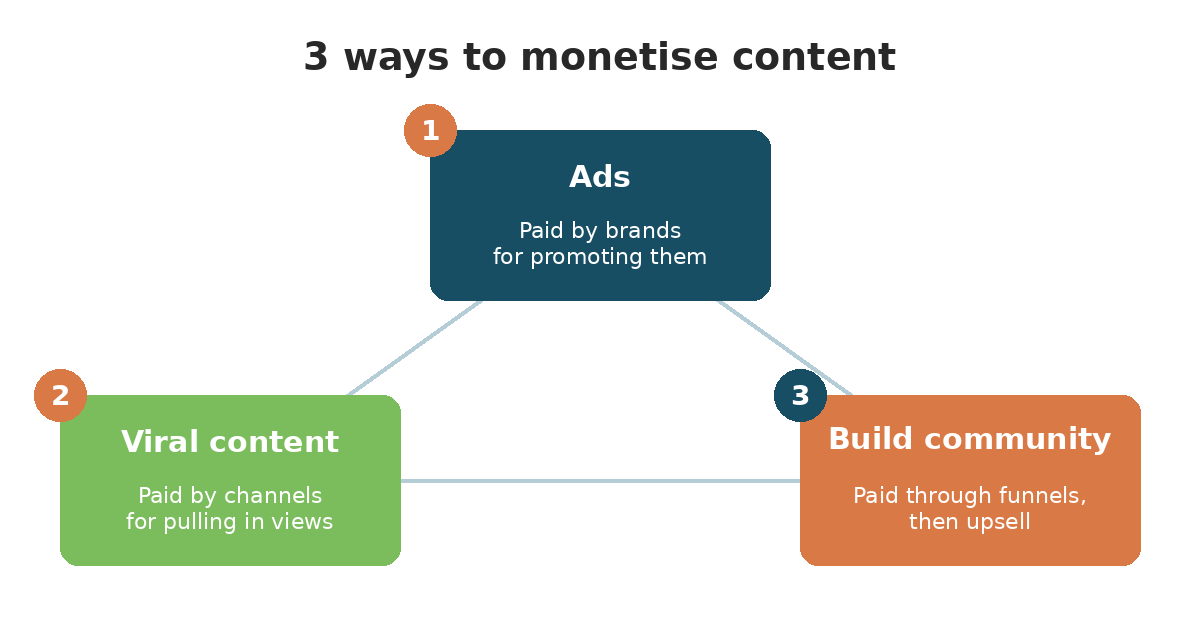
There are generally 3 ways to generate revenue from content:
Ads: Paid for promoting brand
Viral content: Paid by channels
Build Community: Paid through funnels, then upsell
1 - Brand Deals/Ads Videos: paid by brands
Ads have the end state of getting humans to undertake some form of an action.
Some ads do this via persuasion, some through reminders, some through awareness.
The most effective nature of an ad and the relevant creative is dependent on the product, customer type and journey stage.
Customer journey stages:
Unaware
Problem Aware
Solution Aware
Company Aware
Customer
Repeat visitor
Customer types
The Sure Things: While they may convert easily, efficient use of multiple touchpoints can reinforce their decision and potentially increase lifetime value without significant additional cost.
The Persuadables: These customers often require multiple, well-timed touchpoints for efficient conversion. A multi-touchpoint strategy can guide them through the decision process more cost-effectively than repeated single-channel efforts.
The Lost Causes: Multiple touchpoints help in efficiently identifying these customers early, preventing wasted resources on ineffective targeting.
The Do Not Disturbs: For this group, a carefully planned, minimal multi-touchpoint approach is often more efficient than persistent single-channel efforts that may backfire.
When crafting ads, leveraging the attention utilisation formula referenced in dimensions of attention optimisation, a few different approaches may be used.

A video with high virality likely will have low brand visibility or maybe even not excessively positive association, would be good for awareness, which may be great to remind the sure things or existing customers to buy your product (which they already love). It may also be great to increase awareness of your product or brand, which in turn will increase the focus levels given to (i.e. strength) of a future ad, and as a result would be classed as an effective ad.
Often in fulfilling their objective of brand visibility, association and reaching their target audience, adverts will lose viral features and therefore need spend put behind them to enable them to reach the right individuals.
What matters when generating ads
There are dozens of types of ads, that serve different purposes, but those that usually aim to revoke a response use the below structure:
Hook → Body → CTA
Sovran’s diagram and piece on this is very good.
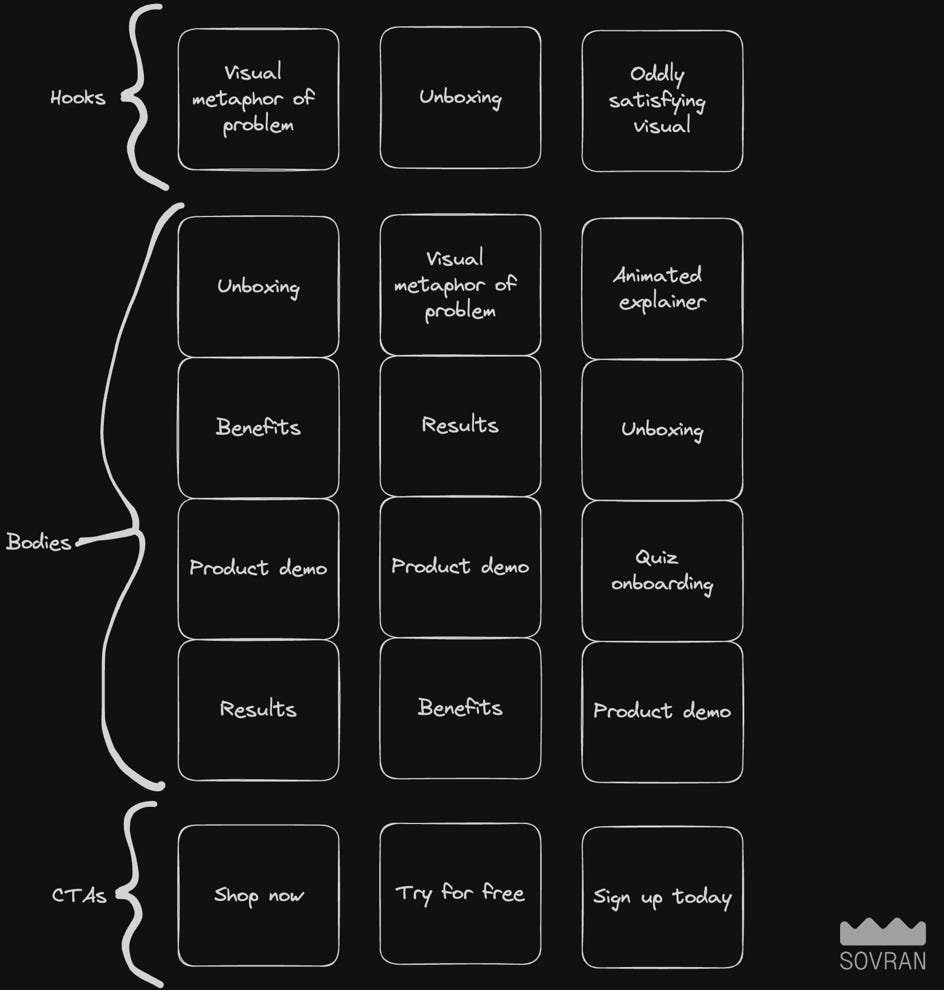
There are three additions I’d add to Sovran’s overview.
WHAT works best on WHO.
Different ad formats will work on different customer sets all with differing customer lifetime values, it’s important to identify what within content works best on who.
Increased specificity of every script, music, and visual data point that is affecting content performance – using computer vision.
At what point in time. Ads fatigue very quickly as people see them, so always need new inspiration.
2 - Viral content: paid by channels
Viral content works on a similar formula, except that instead of optimising for brand visibility, it optimises for viewcount, which is driven by how well it’s prioritised by the algorithm.

For more detail on the algorithms, I’d watch the following three videos, but a short summary is that social platforms want to maximise the quantity of strength of the attention that they capture, so anything that optimises those outcomes or the steps that social platforms are taking to get to those outcomes should increase virality.
In short the things being prioritised right now are:
Things that get people onto the platform
Intentional search – videos that people search that’ll get them onto the platform – for these you want quick, visual and highly insightful answers to those searches
Video shares – so highly shareable content is doing well
Things that keep them on the platform
High retention videos – 1 min + videos, very engaging content, with a strong hook (to stop scroll), then strong promise, and then an end point that comes too soon to stop scroll behaviour (often meaning the promise isn’t fulfilled) -

 Tiktok failed to load.
Enable 3rd party cookies or use another browser
Things that keep them engaged over passive scrolling
Quizzes
Riddles
Questions
Things with high comment rates
Note that they are also becoming far more specific, so it’s about appealing to niche audiences with niche content, as algorithms have gotten better at having content reach audiences
3 - Build Community, funnels to upsell: paid by community
Note that this is distinct from viral content, as virals generally aim only to get views, whereas community growth aims for mass views, but is much more focused on user retention, awareness and future intentional search for themselves, in the hope of long term purchase.

In the same way that before celebrities would be seen as a sign of credibility, social creators are becoming credible in certain niches and that is generating value.
Value they bring can be split into:
Awareness – from posting videos on their channels that get views
Credibility – being seen as a higher trust source on certain topics – especially informational topics to sell courses, or product topics for products.
So in addition to the viral notes above, the content should increase memory of the creator, generate some form of value, or fulfil a call to action.
Other things
Tik tok shop – Tik Tok’s gradually upping it’s commissions on shop, so anything around attracting content to that is doing well. There are also tonnes of shops looking for content on affiliate deals, so any way to ramp up quantity there is exceptional.
Tipping – Tipping behaviour is increasing on Tik Tok in particular, so anything that generates tips
The opportunity
Building the information layer to understand what’s working and then automatically generate it (this automatic generation part will come very soon).
Across all themes of ads, virals, and community content, we have a bunch of:
Insight into what works
Information on manual processes and sources where we can develop and understanding of what
is working – analysing videos working well
will work – trends
AI enables:
Ability to understand image and video content in particular things are scale – computer vision
Ability to interpret that to figure out what to make
Ability to make that content (ad/viral/community content) leveraging existing models