

Income sharing agreements are not a new phenomenon, the concept has existed for decades, with substantial exploration in the 1940s by Milton Friedman and his exploration of human capital contracts. Prior income share agreement tests have failed, including Yale’s “tuition postponement option”, with others failing due to adverse selection problems (more talented borrowers or those targeting high paid careers do not use them) and those who have them being more likely to prioritise non-monetary reward.
New attempts continue to take place, with Purdue university introducing their new student financing options tied to income share, and upstart institutions like Make and Lambda school financing new students through income share agreements, which are then sold as securities to investors. Lambda has recently come under scrutiny for violating California Consumer Financial Protection Law.
However, I believe the fundamentals, particularly for education are strong enough to make take-up at some point an inevitability.
Money now is more valuable to people than money later
a. Incomes generally increase with age, disposable incomes are highest in the latter years of work when incomes are highest and cost of living is lowest
b. Happiness achieved per incremental dollar is also much higher for those on lower incomes and caps off at a certain point ~$75,000
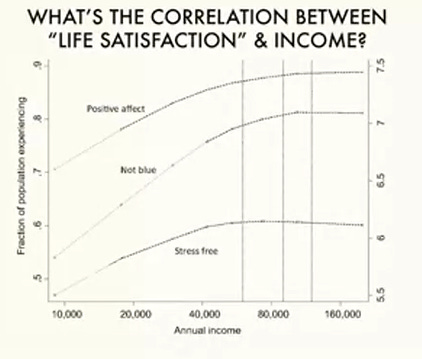
c. Return on investment in education and early career development is high – both for intrinsic skill sets learned, as well as network, signalling and other value
d. Experiences generally generate more happiness than things, and certain experiences are less easily attainable with age for obvious health reasons
Societal benefit
If the investment is skewed towards education and training - the outcomes also include a more skilled and educated workforce. If applied correctly this should correspond to proportionate increases in innovation, and therefore overall improvements in living standards.
Competition for returns ever-growing
Financial institutions are incentivised to find new ways of generating those returns – Friedman and Kuznets (1945) posed that return on investment for human capital was higher than for physical capital
Invest in everything economy growing
As securitisation becomes easier, the ability to invest in different things also becomes easier, from whisky, to art, to music masters
People invest more than they give to charity
Americans donated a total $449.64bn in 2019, 69% of which was from individuals, in comparison, the US stock market had $37.7T invested in it in 2019. Investment that improves prospects for the investee is better if it improves their overall outcomes.
Student debt crisis growing
The actual student debt burden stands above car and credit card debt at $1.6T in 2019 and it is growing at 7% per year, expected to exceed $2T in 2021 and $3T by 2030.
There is an additional mental and physical health burden that has long-term negative impacts on the economy and workforce productivity, not to mention happiness
Additional benefit to human capital investment
The best investors are those who are either super active or completely passive. From active investors, investees will benefit from network access, mentorship, and other decision-making advice, all of which should positively contribute to their earning potential and impact on society
Some fields cannot access debt
Fields such as the creator economy have large groups of people who cannot easily access debt, despite having large amounts of name recognition and decently sized fan bases. Income share agreements can allow people in these high risk and unstable fields to stabilise their incomes and also leverage their fan bases.
Pooled income
Alternatively, this stabilisation can even be done through schemes like pooled income, for example where everyone in the BRIT school class of 2021 can agree to pool 10% of their income, allowing the entire class to try to take more risk in an industry where revenue is concentrated around the 1%. If the class produces an Adele, then the whole class benefits. The rest of the class is the incentivised to help eachother too succeed whilst also having the stability of multiple salaries.
Question
How will the increased adoption of income share agreements affect inequality?
Though at the start these agreements are often being structured as a meaningful upfront cash investment for a small proportion (5-10%) of future earnings limited to a certain number of years post investment, what’s to stop an escalation where investors invest smaller amounts for a more substantial stake (~90%) in earnings?
A classic response to this argument would be that the freemarket would realise that this sort of deal will not create outsized rewards for investors and so the freemarket would not let this happen as it would disincentivise people to work. I fundamentally disagree for 2 reasons:
There are multiple instances where investors have aggressively taken substantial stakes in companies enough so to disincentivise further founder work on the companies? In these instances they have refused to recap or lower their stakes even if this directly led to the future collapse of the company. In the investment game they are often fine to trash a bunch of companies to have a substantial stake in a unicorn. The issue here is that these investments are in people, not companies, and taking too substantial a stake in a human in return for early up front cash seems not dissimilar to modern day slavery.
As society progresses, this sort of investment funding provision that starts out as useful for non-essential items, such as further education or a house (to reduce the stress of paying a mortgage to encourage entrepreneurship) can progress to more essential items. Let’s say for example that everyone around you takes up this financing for early education. As a result everyone else also feels the need to take up this provision so as to not be disadvantaged. This will lead to demand for private education going up, leading to price rises, and state education provision likely decreasing as the resources flood to private education. Over time this could lead to a deterioration in the quality of state education to such an extent that private education becomes necessary for access to even the most basic jobs. If investment doesn’t scale at the same rate then people will be giving more away. Decisions that you made as a kid could affect you for life.
Moreover, this free market approach will likely exacerbate existing trends where demand for investment space in top talent will bid up that price, but for the majority there will not be much funding at all, so the cost of capital goes up!
Assuming that these sorts of income share agreements are going to scale, where should regulation be put in place:
Max investment at each stage?
Necessary state training provision?
Minimum age before investment?
somewhere else?
As always, please do reach out with comments and feedback or feel free to email or message me on LinkedIn or any socials.