

Pros:
Targeted Conversions: Unmatched ability to optimize for specific, high-value user actions (like “Purchase”) instead of just vanity metrics.
Scalable Performance: Clear “Vertical” and “Horizontal” scaling methodologies allow for predictable budget increases once a profitable formula is found.1
Advanced Retargeting: Powerful tools to build full-funnel experiences, nurturing warm (MoFu) and hot (BoFu) audiences with specific creative.2
Creative as Targeting: The modern algorithm allows the ad creative itself to find the perfect audience, making “Broad” targeting highly effective.4
Cons:
High B2B Costs: Can be expensive for B2B lead generation, with leads often being lower-intent (”cheap reach, expensive leads”) compared to platforms like LinkedIn.5
Algorithm Volatility: Sudden budget changes or ad edits can reset the “learning phase,” causing performance instability.4
Creative Fatigue: Relies heavily on a constant stream of fresh ad creative, as even winning ads burn out quickly.2
Requires “Ad-Like” Filter: Unlike viral content, performance ads must be “ad-like” to filter for intent, which can feel counter-intuitive to marketers focused on engagement.
How do Meta Ads work?
Meta Ads (for Facebook and Instagram) is a performance marketing channel that operates on an auction system. The core principle is simple: you tell the algorithm what you want to achieve (your Objective) and who you want to reach (your Audience), and the algorithm uses your Creative (the ad) to find the cheapest, most effective way to achieve that goal.
In the modern ecosystem, the algorithm is so powerful that the “Creative is the New Targeting”.4 The system analyzes the text, visuals, and messaging of your ad to infer the ideal user, often making “Broad” targeting more effective than granular interests.9
The Three Pillars of Meta Scaling:
Objective: The “signal” you give the algorithm. A “Website Traffic” objective will find users who click links, while a “Conversions” objective will find users who buy. This is the most critical setting.
Creative: The ad itself. This is your primary audience filter. A direct, “ad-like” creative repels low-intent users and attracts high-intent buyers.10
Audience: The pool of users you allow the algorithm to fish in. Modern strategy favors giving the algorithm a large pool (Broad) and letting the Creative and Objective do the work.9
Why Meta Ads for Business Growth?
Meta Ads is the most powerful platform for Conversion optimization. It allows you to build a system that is measured not in “traffic,” but in profitable, scalable customer acquisition. While other platforms are great for discovery (like TikTok) 11 or high-precision B2B (like LinkedIn) , Meta is the central engine for turning awareness into customers and retargeting users from those other channels.
Expected Investment
Cost (Ad Spend): This varies by industry. For a local business, a testing budget of $25–$50/day can be effective. For e-commerce or B2B, a minimum of $50–$100/day is often needed to gather enough data to exit the “learning phase”.
Cost (Creative): This is the most important and often overlooked cost. Ad accounts fail because their creatives get stale.2 You must budget for “creative velocity” (a constant stream of new ads).
User-Generated Content (UGC): Sourcing video from individual creators typically costs $150–$300 per video.
Polished/Agency Creative: This is often part of a monthly retainer, which can range from $500 to $10,000+ per month, but includes strategy, design, and management.
AI-Generated Creative: Tools that generate ads using AI can be cheaper, with platforms like Arcads charging around $11 per video on starter plans.
Time: 2–4 weeks for an initial testing phase to find a “winning” ad. Scaling is an ongoing process.
Expected ROI, if executed well
Average Conversion Rate (CVR): This is highly industry-dependent. The average CVR across industries is approximately 8.95%, but this can be higher for categories like Restaurants (18.25%) and lower for e-commerce (2%–2.7%).
Average Return on Ad Spend (ROAS): A median ROAS for B2C businesses is 1.79 (meaning $1.79 back for every $1 spent). A healthy target for a scalable campaign is a 2.0+ ROAS on prospecting (cold) audiences and a 4.0+ ROAS on retargeting (warm/hot) audiences.
Meta Ads Strategy for Business Growth
Strategy 1: Foundational Campaign Setup
This strategy covers the non-negotiable setup for any business looking to get real results from Meta.
1. Define Your Unit Economics
Before you spend $1, you must know your numbers.
Lifetime Value (LTV): How much is a customer worth over their lifetime?
Maximum Allowable CPA (Cost Per Acquisition): Based on your LTV and profit margins, what is the absolute most you are willing to pay to acquire one new customer? This is your primary “guardrail metric.”
2. Set the Correct Campaign Objective
This is the most common and costly mistake.
Do NOT use: “Website Traffic” or “Engagement.” The algorithm will obediently find you cheap clicks and likes from users who are behaviorally unlikely to ever buy anything.
ALWAYS use: “Conversions” (or “Sales”). This instructs the algorithm to find a much smaller, more expensive, but higher-intent audience that is behaviorally similar to your past purchasers.
3. Create Your Initial “Ad-Like” Test Creatives
Your first ads should be direct and clear. Do not try to be “viral.” Create 2-4 initial creatives to test.
Example Ad 1: A “product-focused” ad (e.g., a clean image or video of the product in use).
Example Ad 2: A “problem-focused” ad (e.g., a “pain-point” headline that your product solves).
4. Launch & Test
Run your initial campaign (Objective: Conversions) to a Broad audience. The goal of this first 5–7 days is not to be profitable, but to gather data: Which creative has the lowest CPA? This “winner” is what you will begin to scale.
Strategy 2: Advanced Creative Strategy (The “Ad-Like” Filter)
This is the core nuance of performance advertising. You must intentionally use “ad-like” creative to filter for high-intent users, even if it means paying more per impression.
1. The “Ad-Like” Creative as an Audience Filter
An “ad-like” creative (e.g., a direct product shot, a dashboard screenshot, a clear offer) is an asset that is unapologetically a commercial. It functions as an immediate, passive filter:
Low-Intent Users: The majority of users scrolling for entertainment will see the ad, instantly recognize it as a commercial, and scroll past. This is a positive outcome, as it saves you the cost of a useless click.
High-Intent Users: The small, high-value segment of the audience that has the problem you solve will see the ad, recognize the solution, and immediately stop. The ad has successfully repelled the low-intent audience and attracted the high-intent one.
2. The Core Nuance: High CPM vs. Low CPA
This strategy intentionally accepts a higher Cost Per Mille (CPM) because it is targeting a more valuable audience, which in turn leads to a lower Cost Per Acquisition (CPA).
Strategic Rationale (High CPM): A high CPM is not bad; it’s often a symptom of success. When you target a “Conversions” objective with an “ad-like” creative, Meta seeks out a “higher value customer who costs more”. This audience is highly competitive, driving up the auction price (CPM). A high CPM is confirmation you are in the correct, high-value auction.
Strategic Rationale (Low CPA): Because the “ad-like” creative has pre-qualified the click, the user who lands on your site has high commercial intent. This leads to a dramatically higher Conversion Rate (CVR) from that click, which more than offsets the high CPM and results in a lower, more profitable final CPA.
3. The “Viral Content” Trap
Marketers often try to use “native” or viral-style User-Generated Content (UGC) for cold audiences. This is a trap.
The Paradox: Viral content is designed to be entertaining.13 This results in low CPMs (it’s a cheap, general audience) and high CTRs (it’s engaging).
Strategic Rationale: This creates the “high CTR, low conversion rate” paradox. The user clicks because they were entertained, not because they have intent. When this low-intent user hits your sales page, there is a severe disconnect. They bounce immediately. You have successfully paid to entertain an irrelevant audience.
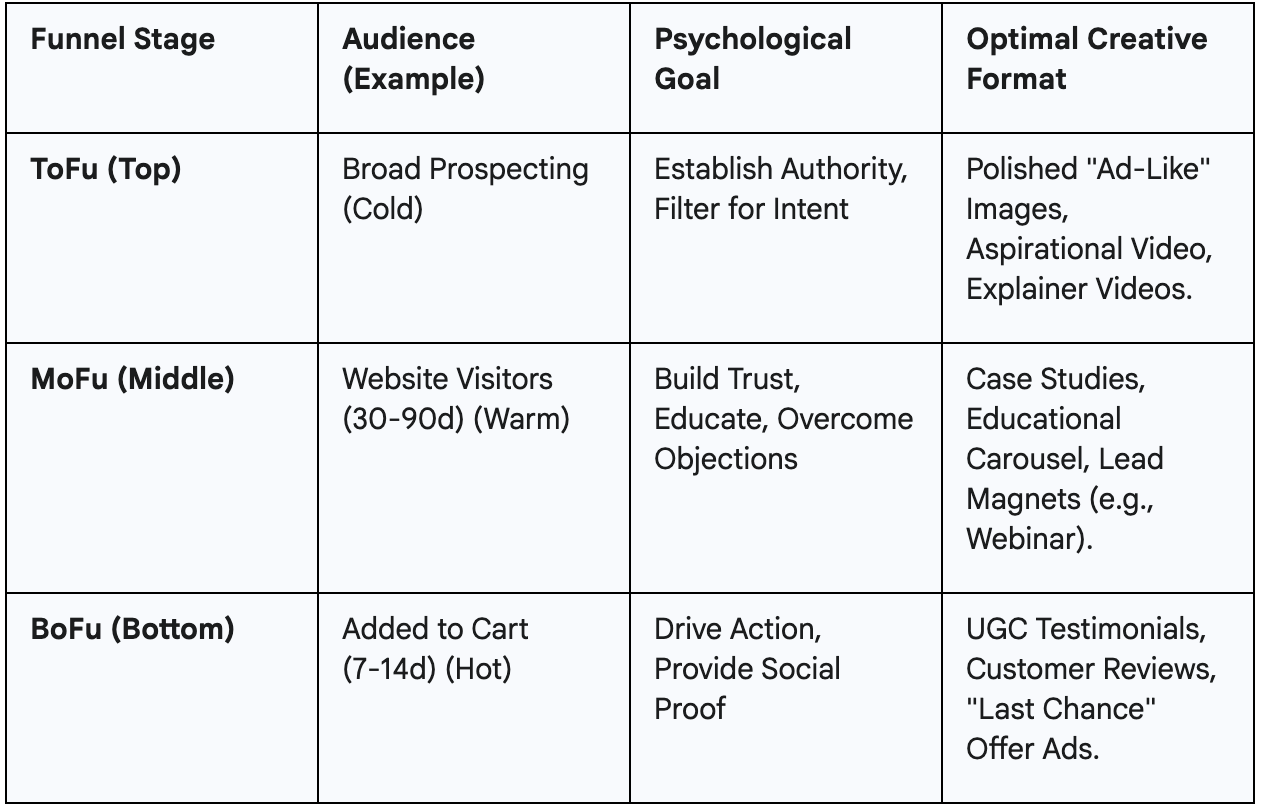
4. Full-Funnel Creative Sequencing
The “Polished vs. UGC” debate is a false dichotomy. A sophisticated strategy uses both, but at different stages of the funnel.
5. Creative Sourcing & Generation
You need a reliable system for “creative velocity” to avoid ad fatigue.2
Manual UGC: Source content directly from creators. This provides high authenticity but can be slower and more expensive ($150-$300+ per video).
AI-Generated UGC: Use AI tools to create realistic, UGC-style videos at scale. Platforms like Arcads or HeyGen use AI-powered human actors to generate direct-to-camera ads, saving time and money compared to traditional shoots.
AI-Generated Video: Use generative AI models like OpenAI’s Sora to create more cinematic, conceptual, or animated ad visuals from simple text prompts. This is useful for creating unique visuals without filming.
Strategy 3: Advanced Audience & Scaling
Once you have a “winning” creative and a full-funnel strategy, you can begin to scale.
1. Modern Audience Targeting (”Creative is the New Targeting”)
The Shift: Forget granular interest-stacking. In the modern ecosystem, your creative is what tells the algorithm who to target.4
The Great Debate: Broad vs. Lookalike: Broad Targeting (e.g., setting only age, location, gender) now consistently outperforms Lookalike Audiences.
Strategic Rationale: Lookalikes are restrictive and based on past data. Broad targeting gives the algorithm maximum flexibility to use your “Conversions” objective and “Creative” signals to find new pockets of customers in real-time. Data shows Broad targeting results in a higher ROAS and 45% lower CPMs than Lookalikes.
2. Scaling Mechanics (Vertical vs. Horizontal)
When you have a profitable ad set, there are two ways to scale it 1:
Vertical Scaling: The “slow and steady” method. You increase the budget on your existing winning campaign or ad set.
Best Practice: This must be done slowly. Increase the daily budget by only 20-30% every 48-72 hours. A larger, sudden jump will reset the “learning phase” and destroy your performance.4
Horizontal Scaling: The “diversification” method. You duplicate your winning ad set and change one variable, such as testing new ad creatives or new broad audiences (e.g., different countries).
Advanced CBO Synthesis: The most effective scaling method combines both. You use a Campaign Budget Optimization (CBO) campaign. To scale, you increase the total CBO budget by 25% (Vertical) and, at the same time, duplicate your single best-performing ad set inside that same CBO campaign (Horizontal). This allows Meta to feed the new budget to the proven winner while also testing its “clone” for further growth.
Action Plan (2 Months)
Week 1 (Preparation):
[ ] Define Unit Economics (LTV, maxCPA).
[ ] Set up Meta Pixel & Conversion API.
[ ] Research 3-5 competitor ad styles using the Meta Ad Library.
Week 2 (Creative Sourcing):
[ ] Brief & source initial creative assets: 2 UGC-style videos (either manually or via AI tools) and 2 polished “ad-like” static images.
Week 3-4 (Testing Phase):
[ ] Launch initial Prospecting campaign (Objective: Conversions, Audience: Broad).
[ ] Run one CBO campaign, testing your 4 creatives in separate ad sets.
[ ] Run for 7-10 days until you have clear performance data (e.g., 50+ conversions).7
Week 5 (Analysis & Funnel Build-Out):
[ ] Identify the “winning” creative/angle with the lowest CPA. Pause the losers.
[ ] Launch a Retargeting campaign (MoFu/BoFu) targeting Website Visitors and Engagers with your UGC/testimonial creative.15
Week 6-8 (Scaling):
[ ] Apply Vertical Scaling to your winning Prospecting CBO (increase budget 20% every 3 days).
[ ] Apply Horizontal Scaling by launching 2 new creative “hooks” based on your winning ad, testing them against the original winner.16
Relevant Tools & Learning Resources
Tools:
Meta Ad Library (Competitor research)
Canva / CapCut (Creative design & editing)
ChatGPT (Ad copy & headline brainstorming)
AI Creative Tools: Arcads, HeyGen (for AI-UGC ads); OpenAI Sora (for text-to-video ads).
Learning Resources:
Facebook Ads Tutorial - 2024 FREE COURSE for Beginners
Ad Format Specs & Recommendations
How To Advertise on Facebook in 2024
Summary
Total cost: $1,500–$3,000/month (Recommended minimum testing ad spend).
Expected timeline: 2-3 months to find a stable, scalable formula.
Expected ROI: Varies by industry. Aim for a blended ROAS of 2.0+.