

Pros:
Precise Targeting: Filter by Title, Company, Industry, and Group Membership (ICP fit)
Visual Credibility: Profiles show shared connections, endorsements, and history
Contextual Insights: Real-time activity on posts, comments, and company news helps craft personalized outreach
Cons:
Volume & Automation Limits: LinkedIn restricts mass automation, requiring manual personalization
High Effort/Time: Each message must be context-aware and thoughtful
Connection Saturation: InMails and requests can be ignored or treated as spam
How does Targeted Outreach on LinkedIn work?
The ultimate goal of LinkedIn is to transition the conversation to a dedicated sales environment.
Social Selling works by leveraging LinkedIn’s professional data to identify and engage high-fit prospects. The core mechanism is:
Build rapport before pitching by engaging with a prospect’s content or referencing their company’s activity
Move the conversation to a call or demo using contextual, personalized messaging
Track engagement with Social Selling Index (SSI) metrics
Why LinkedIn Outreach for [B2B SaaS Product]?
Precision Targeting is Unmatched: You can hyper-filter prospects by industry, job title, and company size, ensuring every message lands with an ideal customer profile.l
Builds Instant Trust: The platform inherently provides social proof (shared connections, job history, profile picture), eliminating the cold barrier of email or phone.
Contextual Goldmine: Real-time visibility into the prospect’s activity and company news allows you to initiate conversations based on genuine insights (”Why Now” triggers).
Quality Over Quantity: The personalized nature of the message drives higher engagement and qualified meetings than volume-based tactics.
Expected Investment for X Company
Cost: $80–$150/month (Sales Navigator/Premium) + $3,000–$6,000/month per SDR/AE
Time: 4–6 hours/day for manual prospecting, research, and engagement
Expected ROI
Qualified meetings: 5 –10/month per SDR/AE
Conversion (Meeting → Closed-Won): 20%+
ROI measured via Opportunity Value and Pipeline Velocity
LinkedIn Outreach Strategy
Strategy 1: Profile Optimization & Credibility
1. Optimize for Discovery & Engagement
Most important thing: your Headline is a Hook, Not a Title: Ditch the generic job title and use the 120 characters to state exactly how you solve your audience’s problem, this drives immediate interest.
Winning Formula: The tagline must encapsulate the B-E-N-E-F-I-T your customers receive. It should be a strong positioning statement, often following the “I help X do Y through Z” model.
Be a Keyword Magnet: Strategically weave industry-specific keywords into your headline and summary. This is how LinkedIn’s algorithm connects you with recruiters and clients searching for your skills.
2. Prioritize Trust and Relatability
Headshot: Use a clear, professional 400x400 pixel headshot to make yourself instantly recognizable, which directly increases the acceptance rate of your connection requests.
Sounds silly but the Photo. The photo must make you relatable to your ideal prospect. If your prospects wear suits and ties, you should too. It must be a professional headshot.
Ditch the Third Person: Write your summary using the first person (”I”) and a conversational tone.
Framework: Use clear headings like “WHAT I DO,” “HOW I DO IT,” and “WHO I WORK WITH” to provide an overview focused on value, credentials, and testimonials.
3. Ensure Strategic Clarity
Maximize the Summary’s Value: Use the available 2,000-character limit to convey crucial professional information, especially if you are senior or sell high-priced services. Don’t waste the space!
Always Include a Clear Call-to-action: End your summary with a direct Call to Action. Explicitly tell the reader the next step, such as “Set up a time to chat” or “Sign up for a free trial.”
Exemplar Profile:
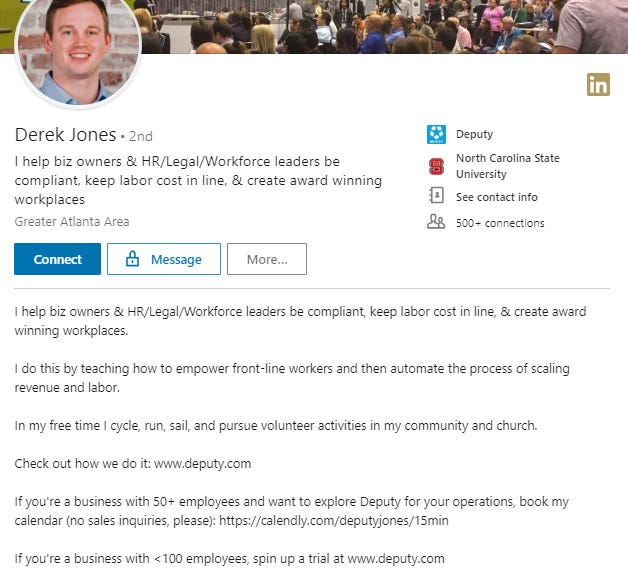
Note:
Niche is a Multiplier: The stronger and more specific your business’s niche, the more leads and sales you will generate. The document provides examples of accountants: a generalist generated one lead, while a well-niched specialist had to turn off their campaign after generating 51 qualified leads, 29 quality phone calls, and 11 meetings in 30 days.
Defining the Niche: The recommended framework for defining your niche is filling in the blanks: “We help X do Y through Z”.
X = Your Target Customer.
Y = The Benefit You Bring Them.
Z = How You Do It.
Strategy 2: Hyper-Personalized Outreach Framework
The strategy to follow here
The Drip Structure: The process involves: 1) A casual connection request, 2) A “Thanks for connecting” message, 3) Sharing useful content/an article, and 4) Asking for a meeting
Sales Navigator is Mandatory: To generate business systematically and sustainably, you MUST use LinkedIn Sales Navigator to find your highly targeted market.
Connection Volume: Start with around 20 connection requests per day and slowly ramp up to a maximum of 50 per day over two to three weeks to avoid being flagged by LinkedIn.
Messaging Principles (The Bananarama Syndrome):
Keep it Real: Messages must read like you typed them out in two minutes (e.g., while eating a bagel at Starbucks).
Avoid Hype: The message must be completely personal, believable, one-to-one, and free of marketing hype. Hyperlinks are a dead giveaway and should be avoided.
Talk About Them: Ask questions about them more than you talk about yourself; this is way more effective than “puking” about your product.
The Follow-up: If a prospect does not respond to the “Thanks for connecting” message, the next step is to create value by sending a useful, relevant article (ideally one that is not written by you).
Sell the Meeting, Not the Product: Do not give a full sales pitch on LinkedIn. You are selling the call or the meeting, not your product or service.
Frame the Benefit: The meeting request should be framed in a way that is BENEFICIAL to the prospect (e.g., “I can work around your diary,” or “I’d see us as a complimentary offering and a logical revenue stream”).
Inbound Engagement: An additional, passive tactic is using a profile-visiting tool to automatically view the profiles of target prospects, which triggers the “Who’s Viewed Your Profile” notification. This often results in prospects connecting with you, shifting the dynamic entirely.
Alternate Outreach Options - pattern interrupts
1. LinkedIn Voice Notes (The High-Velocity Interrupt)
Impact: Adding a voice note can boost reply rates by 30% to 40% compared to text-only messages.
Best Practice: Keep it Concise: The optimal length is 30 to 45 seconds (maximum 60 seconds). Avoid rambling to fill the minute, as shorter messages perform better.
Best Practice: Be Authentic: The message should feel like a natural conversation, not a script. Try smiling when recording :))
Usage: They are best used as a follow-up or interrupt after a connection is made (to 1st-degree connections) and should be used sparingly in contexts where listening is impractical.
Advanced Tip: One strategy is to ask permission to send a voice note first. If the prospect says yes, it gauges their interest and removes the “sting” of cold outreach.
2. Personalized Video Messages (The Visual Interrupt)
Video provides a superior level of personalization that text cannot match, creating a more memorable experience.
Impact: Personalized videos can result in a massive boost in responses and meetings booked, especially for high-value accounts.
Pattern Break: Screen Recording: A powerful interrupt is creating a screen recording where your face appears in the corner while you actively show and reference the prospect’s own LinkedIn profile or company website in the background. This proves you did your homework.
Content & Length: Keep videos concise, ideally under 90 seconds (with a maximum of 3 minutes for complex topics).
Technical Quality: Add subtitles or captions, as over 55% of LinkedIn traffic is on mobile devices where sound is often off.
Strategy 3: Sales Navigator & Automation Governance
Sales Navigator is a LinkedIn tool that allows you to search, filter, and find high-potential decision-makers by leveraging advanced filters on the platforms proprietary data.

Leverage Warm Paths (Connections): Actively use the tool to find hidden allies (people outside the buying committee) and monitor your shared network to secure warm introductions, which accelerates the sales cycle. Warm leads are 5x more likely to convert than cold calling leads.
Action Plan between
Week 1 (Preparation):
Audit and update LinkedIn profile (headline, About, pinned post)
Build Target Account/Lead lists using Sales Navigator
Develop 5 highly personalized 3-line message templates
Week 2–12 (Execution):
Daily engagement: 30 min/day liking/commenting on prospect content
Outreach cadence: 10–15 connection requests and 5–8 follow-ups daily
Incorporate voice notes in 50% of Stage 3 CTAs
Summary
Total cost: $80–$150/month + SDR/AE salary
Timeline: 3 months to establish routine and measure response
Expected ROI:
5–10 qualified meetings/month per SDR/AE
20%+ closed-won rate
Measured via Pipeline Velocity and Deal Quality