

Preface: Passivity is the only regrettable choice
Action and inaction are both choices.
All actions are an allocation of time, with an opportunity cost.
Delaying gratification is difficult; however, doing so is incredibly valuable.
Passivity is inaction with regards to time allocation, often driven by a desire to not delay gratification. Passivity is in my view the only poor career decision.
Reflecting back on my career so far, I’ve had numerous ups and downs, and I regret none of them. I’ve made active decisions to take substantial risks early on in my career and chosen to pursue more novel experiences at the expense of ensuring that those experiences are good. The only times I do regret are the ones where I have been passive – whether for days, weeks or months.
Being passive is often a result of trying to do too much at once and in turn making no progress on any of your goals. It is also a product of being around people who behave passively. Passivity is in my view the single driver of stagnating your career, and the only thing I actively discourage you from doing.
Introduction
Over the past 9 years, I have had an active say in how my time was allocated. From the ages of 16-18 I opted to go to sixth form and sit my A-levels in Maths, Economics and Chemistry. From 18-21 I studied Psychology & Philosophy at Oxford – whilst continuing to commit around 20 hours per week to my magic career, and the summers to exploring different potential careers – some paid and some unpaid. Post that I spent several months exploring creative magic opportunities in India before beginning a 2.5-year stint at McKinsey. Most recently, I’ve spent 1.5 years at a web3 start-up, taking the company as employee #1 with 3 part time founders, through a $10.3m raise and to a team of 12 people. At this point in time, I have decided to relinquish formal work to get deeper on the future impact I’d like to make: leveraging new technology in creator economy and India.
In this process of multiple active learning experiences, jobs, and periods of free time; as well as through working on side projects and learning opportunities throughout my career, I’ve come up with a framework for how I assess career, learning and other opportunities framed around three core time use categories.
The reason the split is so useful is that it ensures an active thought process in how time is used, rather than resorting to defaults.
3 Uses of Time: Learn, Earn, Live
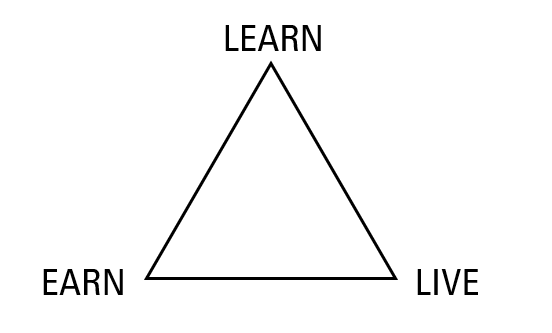
I’ve split my time uses into learn, earn and live. All three of the categories directly impact one another over the long term and all opportunities will provide a different balance of each, both at the start of a career and as you progress.
Learn
There are two core types of learning: active and osmotic
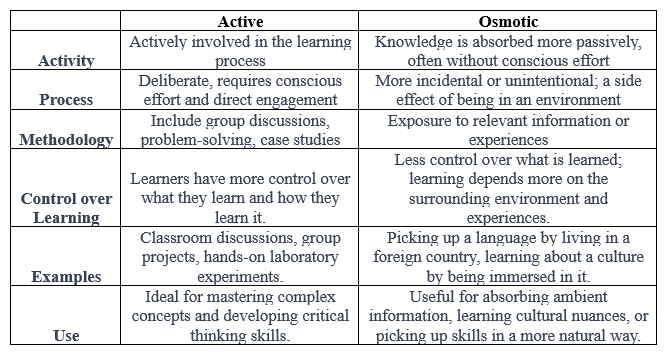
When assessing the value of active learning in a potential opportunity, it’s worth assessing how much that learning or qualification will have in the type of opportunity you will then have available to you.
Accountancy firms often realise that your value goes up substantially post qualification so save their large internal pay bumps until then, or alternatively require you to pay back “fees” if you leave within 2 years of qualifying (charging you for the active learning you receive).
As you go through life and your career, learning goes from centred around active learning to centred around osmosis learning. Osmosis learning is much more subtle – whether it be learning how to behave in a meeting, how to negotiate, how to communicate concisely. The best way to measure the likely level of osmosis learning you will receive is based on:
Quality of people you work with: great people attract and grow even more great people
Time Spent: with these great colleagues
Progression: Quality improvement of other people at said potential employer from the start to when they leave a role
Feedback culture: at said organisation – regular feedback from people previously in your position allows you to identify core osmotic learnings picked up or for the creation of more situations of higher osmotic learning.
The best learning combines both active and osmotic learning with active being used to grasp core concepts and pieces of knowledge and osmotic to pick up the nuances that enable you to better leverage that active learning.
Learning in all forms compounds:
As learning compounds, optimising for it is more beneficial particularly early on in your career or in a field. Moreover, with the exponential growth of technology, ability to leverage new tooling becomes more valuable. Graduates today will likely need to reinvent their competencies multiple times over the course of their careers.
Learning is more controllable early in your career as:
At earlier career stages you tend to have more time outside of work which can be used for active learning
Colleagues see the value of you doing learning early as the results are more visible on your performance and therefore their workload
Expectations on more junior employees are generally lower as they are paid less
As such, optimising for learning early on in your career is a great move.
Returns on learning diminish with time in most organisations despite compound benefits
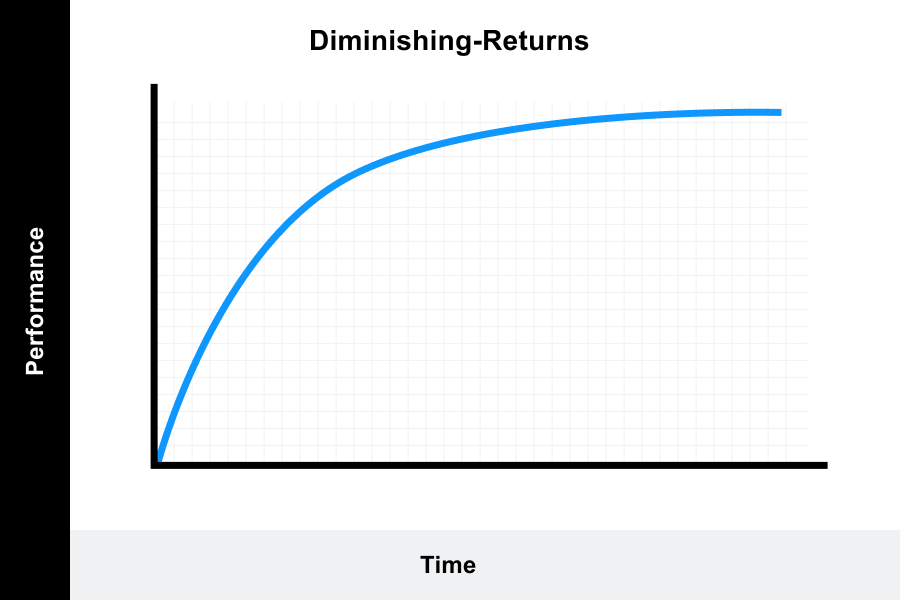
As such, to ensure optimal learning you often have to search for it through exposure to more novel scenarios or otherwise. A good heuristic to use is that you can generate most of your active learning in a job in a year. After that year your skills should open you up to more osmotic learning opportunities, which also taper off after a year. So a 2 year window is often seen as an appropriate time in a role.
Earn
There are three core components to earning:
Net Adjusted Compensation
Signalling: Credibility/Credentials
Connections
In terms of compensation it's important to note compensation post tax, and some form of cost of living adjustment, and then determine a net adjusted compensation.
Net Adjusted Compensation
This is the net (post-tax) amount that you earn, adjusted for cost of living (i.e. the amount you’d save per month), likely with some additional adjustment for lifestyle.
Net adjusted compensation = Net salary x cost of living adjustment x lifestyle adjustment
Cost of living adjustment: the adjustment needed to account for differences in living cost in different regions. Major cities like New York are generally more expensive than suburbs or developing regions. There are several calculators online to help you adjust for this.
Lifestyle adjustment: the expected change in lifestyle associated with living in a different region. People are aware that if they move from working in India to London they will likely not have any or as much domestic help.
I break down compensation, particularly for start-ups in more detail in [this post to be released soon].
Signalling: Credibility/Credentials
The second form of earning is around signalling value – the credibility and credentials that doing a certain job or task will earn you.
Signalling in most careers comes from three areas:
The bar for getting into said company
Skills that people expect that you have learnt by virtue of having done a certain job
Any qualifications you can gain through doing a certain role (e.g. ACCA).
Large corporate names, such as Goldman Sachs, McKinsey or Google churn out enough graduates that relevant future employers generally know the bars that employees of these firms have already jumped, and the skillsets that these graduates possess after training there. Similarly, other more niche but respected entities such as Bridgewater, or Jane Street have smaller graduating class sizes but are also known for notoriously high entry bars and graduate growth prospects, which again leads to strong signalling value on exit (should you choose to leave – more often smaller reputable firms do everything possible to retain talent).
The value of signalling helps on multiple fronts, from making it easier to establish credibility in cold emails or other application processes. It often also increases the floor on which you’d land if you took a career risk that did not pay off. This enables you to take more risk.
Connections
Alongside providing signalling value that makes it easier to establish credibility, the connections that come from different roles are also a form of value that should be accounted for.
A substantial proportion of the job market is off grid – circling via individuals or recruiters. Smaller companies often don’t have specific roles that they hire for and instead just hire individuals based on their availability, proximity to the problem and desire to join the company.
This is perhaps one of the greatest differentiators between large and small companies. Where smaller companies will have fewer people with identical or similar functions, and therefore likely personality types, and future role / life ambitions; larger companies, especially professional services firms, have lots of similar people with similar ambitions.
As such; though being at a smaller firm may give you more exposure to senior or external stakeholders as you showcase your specific expertise, larger firms allow for you to work with a large group of stakeholders. This is beneficial throughout your career.
My first job in management consultancy has an alumni dashboard, and the London prior and current analysts all have a whatsapp group on which we asks all sorts of random questions – many have gone on to found incredible startups so having a group of them to bounce ideas around with is invaluable; many others hire or send job opportunities to the group.
When I left McKinsey, to enter the world of Web3, after meeting a fellow alumni member in an investors community, we set up a group (DAO) specifically for former McKinsey consultants in Web3. This group now exceeds 200 members, from partners at the firm, to execs at unicorns, and numerous top tier web3 founders, operators and investors. Working at the firm shows a certain pedigree in getting in as well as training through tenure; more interestingly, everyone is 1 or 2 degrees away from you so can very easily vet (due diligence) you to assess the merits of working with you.
Combine that with the clients, senior firm members, and suppliers you work with, you build an extensive network which means at the very least, you often have a couch to crash on when you travel as a broke startup founder.
A quick note on re-baselining
When switching jobs, compensation is often determined as a premium to existing compensation. There are a few roles for which there are more standardised pay packages:
- More established institutions or schemes with more structured pay and progression scales also provide an opportunity to re-baseline as they are less likely to take prior salary into account when determining compensation.
- Similarly, jobs which are substantially different, or job moves post a training scheme like an MBA also allow you to re-baseline to a higher core number. Geographical moves also provide similar re-baselining opportunities due to cost of living and comparables changes.
As such, if optimising for pay, it may make sense to drop into one of these roles to allow you to re-baseline effectively.
Live
Ability to “live” is defined by both the quantum and ability to leverage that live time. Leverage of time is the ability to use the off time to pursue what you intend to do with that time. The factors that affect time leverage are:
Structure: do off hours enable you to do what you want with your off time
Quality: physical and mental state during that off time

Ability to leverage raw hours depends entirely on what you intend to use the time for. The most common uses of this time are:
Spend time with friends and family
Learn a new skill
Develop a side hustle
Other things that give you joy - e.g. travel
If your objective is to leverage the time you have to learn a new skill or start a side hustle, an optimal scenario would likely be where you have off hours that can fit with your class or side hustle needs, and the energy during this time to pursue those activities with intent.
If your objective is to travel, then even if low intensity shift or on call work gives you lower hours and lower intensity than another job, it likely doesn't let you book holidays or long stints so easily. However, a high intensity project based job which lets you take more substantial breaks in between likely better fits those needs as you can have high quality time off during the off stretches, even at the compromise of lower quality time off during work stretches due to job intensity.
Case study: A lot of consulting firms noted this and now offer additional annual unpaid leave for people to pursue these opportunities. Though you may have less high quality time whilst you're working due to the hours and intensity of the job, access to stretches of unpaid leave to pursue travel goals makes that off time higher quality.
As detailed below, ability to leverage time dramatically reduces with aging, so though financial prudence and compounding is emphasised early, not making time for living whilst young is one of, if not the greatest regrets people face later in life.
Additional Thoughts
Making empty time the default
If you are comfortable that if you have an empty window of time, you will be able to effectively channel that time into good earning, learning, or living; then you are at an extreme advantage as you can optimise for when opportunity arises and be more patient in finding it.
The two core methods to help make empty time the default are:
Keeping burn low
Productively channelling empty time
Keeping Burn Low
“On money: Whether or not money can buy happiness, it can buy freedom, and that’s a big deal. Also, lack of money is very stressful.” – Sam Altman
As Sam Altman noted, money may not buy happiness, but it does buy freedom—and that's a game-changer.
For many, the primary motivation behind work is immediate financial need – if this isn’t you you’re privileged… embrace it.
Ample evidence shows that delaying earning for early learning can lead to greater financial success. Immediate financial needs often constrain our ability to pursue learning or living early in our careers emphasising the benefits of keeping personal burn low.
Side Note: Curiously, there seems to be a scarcity of tools that enable early-career professionals to invest in others' learning by bridging the earnings gap. Remember, earning also empowers us with freedom and the ability to live well. It is essential to recognize that earning and learning are not mutually exclusive but rather mutually reinforcing. When we have the financial runway to embrace empty time, we can seize opportunities for growth, prioritize learning, and unlock our potential.
Productively channelling empty time:
If we are able to channel empty time into other productive activities then we are able to ensure that the bar for staying in a job remains high as the opportunity cost is visible.
There are a few mechanisms that allow for this:
Learning backlogs: I tend to have a list of things that I’d like to learn at the next moment of empty time. These range from learning to code and nuances to AI models, to books that I’d like to read. Depending on the amount of empty time I have and how continuous it is, I will do one of these activities.
Activity backlog: I have a list of activities that are in a backlog (e.g. thesis writing, learning and creating new magic, appointments, getting better at skiing); these are beneficial but not urgent, so good for quiet moments
Bucket lists: I view bucket lists as living opportunities you’d like to do. If there are enough items on this list and enough friends to do them with then usually some these things should map to your empty time.
I view the activities in these backlogs to be worth quite a bit given the value I believe they will have on my life, making the bar for a job quite high.
Countering your own narrative
By keeping burn low to reduce the financial need for work, and productively channelling empty time we’re able to improve the bar that an existing job needs to meet to keep us there. The final challenge lies in the default bias, which often tempts us to stick with the status quo. It is easy to passively continue in our existing jobs, locations or fields. While stability has its merits, too often, people unwittingly harm their careers by neglecting change and growth.
It could be argued that CV gaps or ramp up time for new jobs may mean it is better to stay in a job - I’d disagree as although there may be some CV detriments associated with leaving a job without a replacement or career gaps, most individuals err on the side of caution, detrimentally stunting their professional progress. Having a way to leverage empty time should allow you to counter this CV gap issue, and more aggressively pursue growth.
Similarly, the ramp up time associated with starting a new to job may be more demanding than the existing job, and therefore reduce the ratio of reward to time committed. However, we often underestimate how much our current jobs prevent us from exploring new horizons. By making empty time productive, we liberate ourselves from suboptimal learning experiences, mediocre earnings, and diminished enjoyment. Embracing idle moments allows us to optimize outcomes and intentionally separate learning, earning, and enjoyment. Furthermore, this approach positions us to seize new opportunities when they arise without constraints of employment.
Thoughts on Time
Everybody has an equal amount of time
Your actions shape the quantum and leverage with the time that you have
One of the most curious things about time is that it is seen as an equaliser, but in actual fact its distribution is as unequal as many other resources. Uses of prior time affect the both the quantum and quality of future time. Moreover, everyday people trade time, so there is clear way in which money or other forms of value can help you better leverage time.
The unequal nature of time may make it feel less precious, however if anything it is this fact that makes it all the more precious.
High quantum low quality time is miserable, low quantum high quality time is probably better; high of both feels optimal.
Well used time compounds.
Half life on time
https://twitter.com/sama/status/910895248724828160?s=20
There are numerous learnings from this concept [detailed in this post], but most prevalently here; it’s important to see how this affects how you prioritise – learning, earning and living.
With time, earning ability may increase but ability to leverage time to learn or live decreases. I feel society overemphasises the importance of earning and saving when young (likely driven by insane asset value compounding the past 50 years), but not enough the importance of learning or living.
If time feels longer when you’re younger, I imagine the memories will also stay etched with us for longer and with higher strength. This suggests to me that the impact of living would be more substantial with memories etched from living earlier. Your health is also better when younger, and as such so is your ability to “live”. Living also has compounding effects. If you go to parties, you are more likely to meet more people, who invite you to more parties. If you become the kind of person who prioritises enjoyment, you are likely to find newer ways to create new kinds of enjoyment.
Similarly, learning is affected by your brains neural plasticity which reduces over time. However, this reduction in neural plasticity can also be reduced by ensuring a life of continual learning. People who know two languages, can much more easily learn a third, as both the learning process is very similar, but also the rule learnt for both languages likely overlap with the third language. Similarly, the amount of overlap in learning of different things is exponential.
In all cases of learning, earning and living, the benefits compound. Don’t stray too far in prioritising one at the detriment of the other two.
Final thoughts…
Time is precious.
If you are privileged enough to not need to worry only about immediate financial need, then you should embrace this - optimally using time will yield dividends in the long run. Here I’ve provided one view of how to do this, there are many others.
Do not let time pass passively – actively live every moment. This essay gives an indication of how to assess time use and structure time effectively which should in turn lead to more active use of time.
Thanks for reading about my daydreams. If you enjoy them or have questions or suggestions please let me know in the comments. Would also love for you to subscribe and share with a friend who would enjoy them.