

Pros:
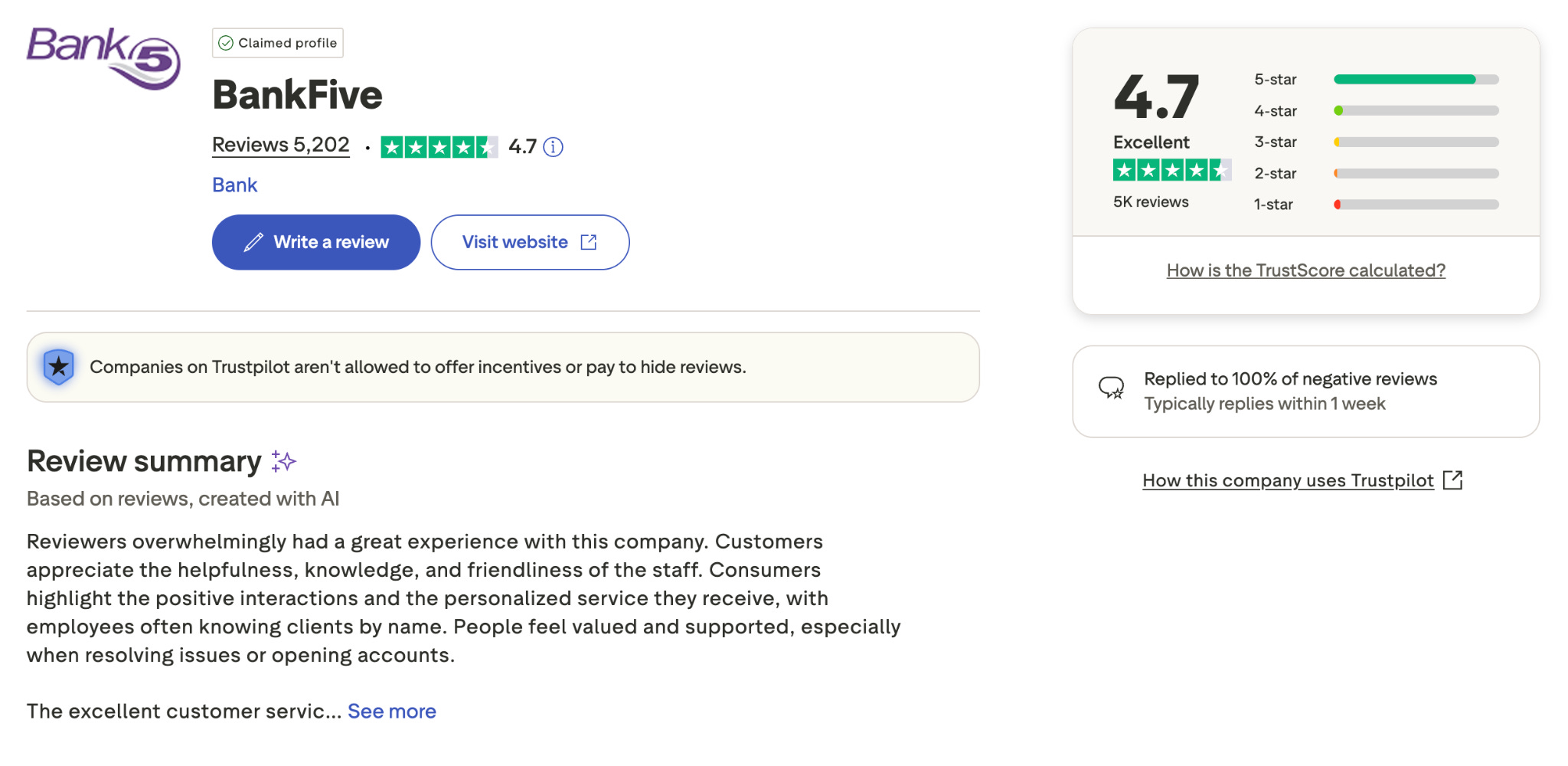
High-Impact Social Proof: Builds immediate brand trust, which is critical for scaling. 63% of EU consumers are more likely to buy from a brand with a good Trustpilot score.
Direct Conversion Uplift: Businesses displaying Trustpilot widgets on their websites see an average conversion increase of 23%.
Acquisition Cost Reduction: Verified reviews fuel Google Seller Ratings, leading to an average 30% uplift in search clicks. This increases ad CTR and lowers effective customer acquisition costs.
Actionable Business Intelligence: Paid plans offer analytics and AI-powered summaries (”Review Spotlight”) to identify operational-level problems and customer sentiment trends.
Investor Validation: For start-ups and scale-ups, a strong, transparent review profile demonstrates customer engagement and validates the business model for potential investors.
Cons:
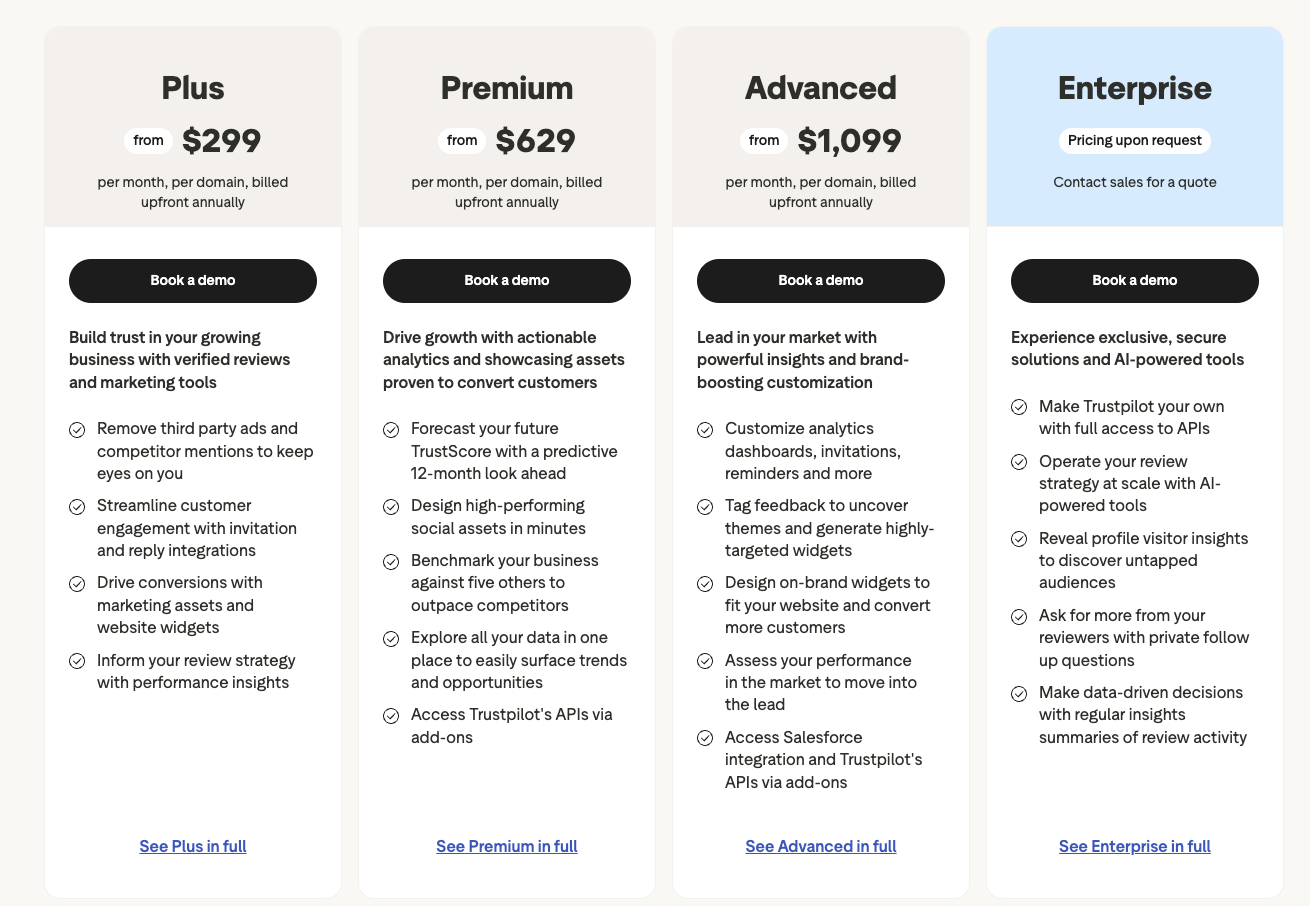
High Cost & Vendor Lock-In: Paid plans are a significant investment ($299 - $1,099+/mo), and contracts are often for a minimum of 12 months. Reviews are not portable, making it difficult to switch providers.
“Open Platform” Risk: As an open platform, anyone can post a review, exposing the brand to unverified negative feedback or even fake reviews.
Mandatory Ad-Removal Fee: The Free plan displays third-party ads and competitor listings on your profile. The “Plus” plan ($299/mo) is the minimum viable investment to remove these.
Requires Active Management: Negative reviews must be responded to professionally and promptly to demonstrate accountability and mitigate brand damage.
How does Trustpilot work? Trustpilot is a global, “open” review platform where any consumer can post a review about a business at any time. This “open” model builds consumer trust, as they know the business cannot censor or hide bad experiences. Businesses can claim their profile for free, but the business model is “freemium”. Scaling businesses subscribe to paid plans to access tools that automate the collection of reviews. Reviews collected via these automated methods are marked as “Verified,” which gives them higher credibility and powers integrations like Google Seller Ratings.
Why Trustpilot for Scaling Businesses? Trustpilot is most effective for businesses where trust is a primary purchasing barrier. This includes:
High-Trust-Deficit Sectors: Financial services, fintech, remittances, and insurance. In finance, consumers are 50% more likely to distrust providers. Since the “ordinary” person is the most trusted voice (62% trust), peer reviews on Trustpilot are one of the only effective marketing channels.
E-commerce & Marketplaces (e.g., Shopify): For online stores, reviews validate merchant quality and product authenticity, which is essential for overcoming the anonymity of online shopping.
Start-ups & Scale-ups: A transparent review profile demonstrates to “potential investors” that the company is customer-centric and actively improving its service.
Expected Investment
Cost:
Free Plan: $0. Includes 50 automated invites/mo but features competitor ads on your profile.
Plus Plan: $299/month (billed annually). Removes ads, adds 200 invites/mo, and basic website widgets.
Premium Plan: $629/month (billed annually). Adds 500 invites/mo, advanced analytics, and competitor benchmarking.
Advanced Plan: $1,099/month (billed annually). Adds 5,000 invites/mo, market insights, and API access.
Time:
Initial Setup: 1-2 days to claim a profile, customize it, and set up basic invitation automation (like AFS).
Time to Value: A commissioned Forrester study found that businesses using Trustpilot achieved a payback period of less than 6 months.
Expected ROI, if executed well
Overall ROI: 401% ROI over 3 years, with operational efficiencies worth over $100,000 per year (per Forrester TEI study).
Website Conversions: ~23% average increase in conversions when displaying Trustpilot widgets on-site.
Revenue (Case Studies): Thriftbooks saw a 180% increase in revenue growth, and Angela Reed drove a 43% revenue increase. Simba Sleep improved its ROI by 20%.
Search & Acquisition: ~30% average uplift in clicks from search (due to Google Seller Ratings). The Forrester study noted a 35% increase in traffic by the third year.
Trustpilot Scaling Strategy
Strategy 1: Foundation & Manual Kickstart
Goal: Establish initial brand control and build a baseline of “Verified” reviews to gain momentum.
Plan:
Claim Profile: Sign up for a business account.
Purchase Minimum Plan: Subscribe to at least the “Plus” plan to remove competitor ads and customize your profile with your logo and description. This is non-negotiable for brand control.
Execute “Manual Kickstart”: Trustpilot allows new accounts a 90-day window to upload a CSV of recent, past customers and send them a bulk review invitation. This is the fastest way to populate your profile with authentic, verified reviews.
Best Practices: Use the 90-day kickstart window immediately to build your initial TrustScore. Do not rely on the Free plan, as it actively promotes competitors on your brand page.
Identify Metrics You Want to Track:
Activity-Based KPIs: # of past customers invited via kickstart, % of new reviews that are “Verified.”
Lead-Based KPIs: (N/A for this channel, focus on conversion)
Conversion KPIs: Initial TrustScore, total # of reviews collected in Month 1.
Strategy 2: The “Review Flywheel” Automation
Goal: Create a high-volume, automated, and continuous stream of “Verified” reviews from 100% of new customers.
Plan:
Choose Integration: Implement an automated invitation method.
AFS (Automatic Feedback Service): The simplest method (even on Free plan). You BCC a unique Trustpilot email address on your order confirmation emails.
Direct Integrations: Use e-commerce plugins (Shopify, Adobe Commerce/Magento, WooCommerce) or API integrations (Klaviyo, Zapier) for more control.
Select Correct Plan: Choose the plan where the “Automated monthly invitations” (e.g., 200, 500, 5,000) exceeds your average monthly transaction volume. Under-investing here throttles your growth.
Optimize Timing: Configure the invitation delay. Instead of sending “immediately,” you can set a delay of 7-14 days to ensure the customer has received and experienced the product, leading to a better review.
Best Practices: Automation is the key to scaling. 88% of companies that introduce automation increase their TrustScore. Always invite all customers to remain compliant and build an authentic review base.
Identify Metrics You Want to Track: Invitation conversion rate , TrustScore velocity (change over time), Customer Satisfaction Score.
Strategy 3: Convert, Market, and Analyze
Goal: Actively leverage review assets to drive on-site conversions and extract actionable business intelligence.
Plan:
Deploy On-Site Widgets: Use the “Essentials” widget library (unlocked on “Plus” plan) to place TrustBoxes on key conversion points like landing pages, product pages, and—most importantly—the checkout cart.
Create Marketing Assets: Use the “Premium” plan’s features to design high-performing social media assets from your best reviews. Display your star rating in email campaigns and ads.
Analyze Feedback: Use “Advanced Analytics” (Premium plan) or AI-powered “Review Spotlight” to automatically summarize thousands of reviews. Identify recurring themes (e.g., “slow shipping,” “easy setup”) to inform operational improvements.
Best Practices: Respond to all reviews, especially negative ones. This shows accountability and builds more trust than a perfect, curated score. Use the “Competitor Insights” feature (Premium plan) to benchmark your performance against 5 competitors.
Action Plan (3 Months)
Month 1 (Foundation & Kickstart):
Select “Plus” plan (or higher based on transaction volume).
Claim and fully customize your business profile page (remove ads).
Compile CSV of customers from the last 90 days and execute the “Manual Kickstart” bulk invite.
Set up and activate your chosen automation method (e.g., AFS or Shopify integration) for all new orders.
Establish a daily workflow for responding to all new reviews.
Month 2 (Automation & Conversion):
Confirm automated invites are firing correctly for 100% of new orders.
Optimize invitation timing (e.g., 7 days post-delivery).
Install TrustBox widgets on your website’s main landing page and checkout flow.
Begin A/B testing widget placement vs. no widget to measure conversion lift.
If on Premium, start creating and testing review-based social media ads.
Month 3 (Analysis & ROI):
Analyze your TrustScore velocity and invitation conversion rate in the Trustpilot Analytics dashboard.
Use “Advanced Analytics” or “Review Spotlight” (if applicable) to generate your first monthly report on customer sentiment themes.
Review A/B test results for widget conversion lift.
Track Google Ads CTR to see the initial impact of Google Seller Ratings.
Calculate initial ROI based on conversion lift and ad efficiency gains.
Relevant Tools and Learning Resources
Tools:
Trustpilot Plans: Free, Plus, Premium, Advanced, Enterprise.
Automation Methods: Automatic Feedback Service (AFS), Direct eCommerce Integrations (Shopify, Adobe Commerce, BigCommerce, Wix, etc.), API, Zapier.
Marketing Integrations: Klaviyo, Hootsuite.
Analytics Tools: Trustpilot Analytics, Competitor Insights , Review Spotlight (AI).
Learning Resources:
Trustpilot Getting Started Guides.
Forrester Total Economic Impact (TEI) Study (for building the business case).
Trustpilot Business Blog & Customer Case Studies.
Summary
Total cost: $3,588/year (Plus) to $13,188/year (Advanced), plus potential add-ons.
Expected timeline: 1-3 months for full implementation and initial data; < 6-month payback period.
Total expected ROI:
~401% ROI over 3 years
~23% increase in on-site conversions
~30% uplift in search/ad clicks
~$100,000+ in annual operational efficiencies
Disclaimer The marketing strategies generated are projections based on available data and case studies and are not guaranteed. Treat as guidelines; success depends on plan selection, consistent execution, and your specific product-market fit.