

Intro/TLDR:
Attention drives belief and emotion. Combined, human attention, existing beliefs and emotions, drive human action. If you understand how to capture attention you can optimise the impact on human behaviour.
With each new technology shift, attention capture has gotten increasingly intrusive and personalised. At each stage, attribution has gotten more complex, as attention capture methods have increased, but also slightly more understandable as content targetting improved.
GenAI now enables instant, low-cost content generation, which enables even more personalised and intrusive content. Instant content generation allows for more specific A/B testing of what combination of content and channels work to persuade who, allowing for a better understanding of attribution. Combined, these changes should enable even better persuasion and targeting capabilities.
Access to hyper-persuasion capability leveraging Gen AI will be of high value, as those who best leverage this technology will be able to impact human behaviour more tangibly than ever before.
When you have the exact right messages, across the exact right channels, at the right time for the right person, you have largely maximised persuasive leverage. Gen AI will be the enabler of this - the final step change.
Why attention matters
Attention drives belief and emotion; which drive action. Therefore: if you understand and optimise attention you can shape human action.
What you pay attention to, defines:
what you believe: religion, other people, the government, morals
emotions: how happy, sad, angry or anxious you are - your emotions
Where you give your attention combined with your existing, belief and emotional state drives action: everything from purchasing behaviour, voting behaviour, feelings and habits.
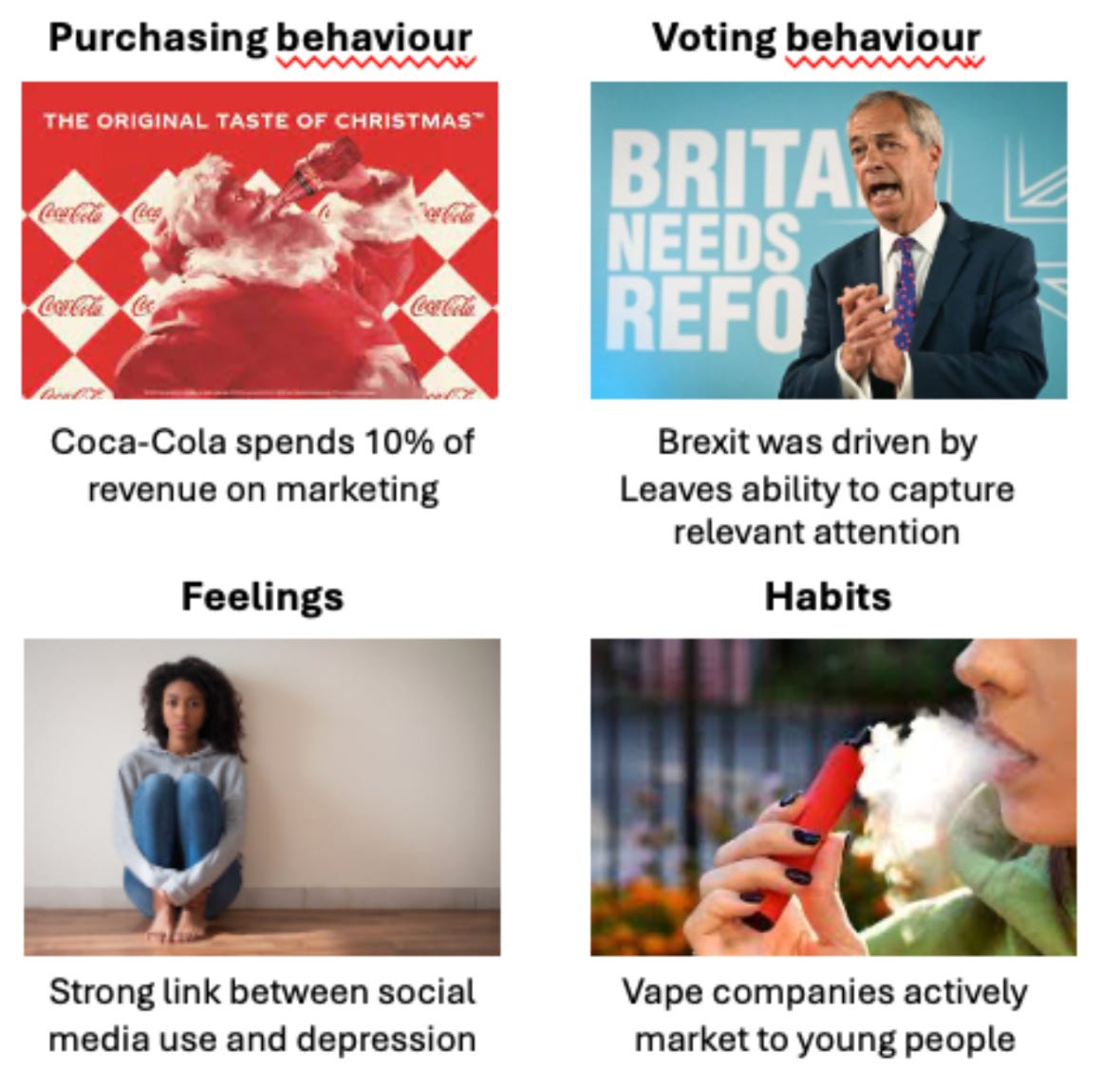
In a business context, attention is the gateway to customer engagement, brand loyalty, and ultimately, sales. By effectively capturing and directing consumer attention, companies can significantly influence purchasing decisions and market trends.
The relationship between attention usage and action is complex, often requiring multiple touchpoints to move someone from awareness to action. By optimising each touchpoint, you can more efficiently take someone from attention to action. As GenAI enables hyper-personalisation and an improved understanding of ad attribution as I discuss below, I hypothesise that GenAI will enable easier assessment of the likelihood of human actions and the touchpoints needed to get them there. For marketers, this means a sizeable improvement in campaign efficiency and effectiveness, with the potential for higher conversion rates and better ROI, at least in the near term. Long-term, it may well be that platform owners reap the rewards and not leveraging Gen AI to hyper-personalise content becomes a disadvantage.
Attention can also have a viral feedback loop
There’s also often a feedback loop where actions based on attention draw more attention to the same topics, potentially amplifying the initial effects of attention capture. This increases the rewards for optimising the initial attention capture.
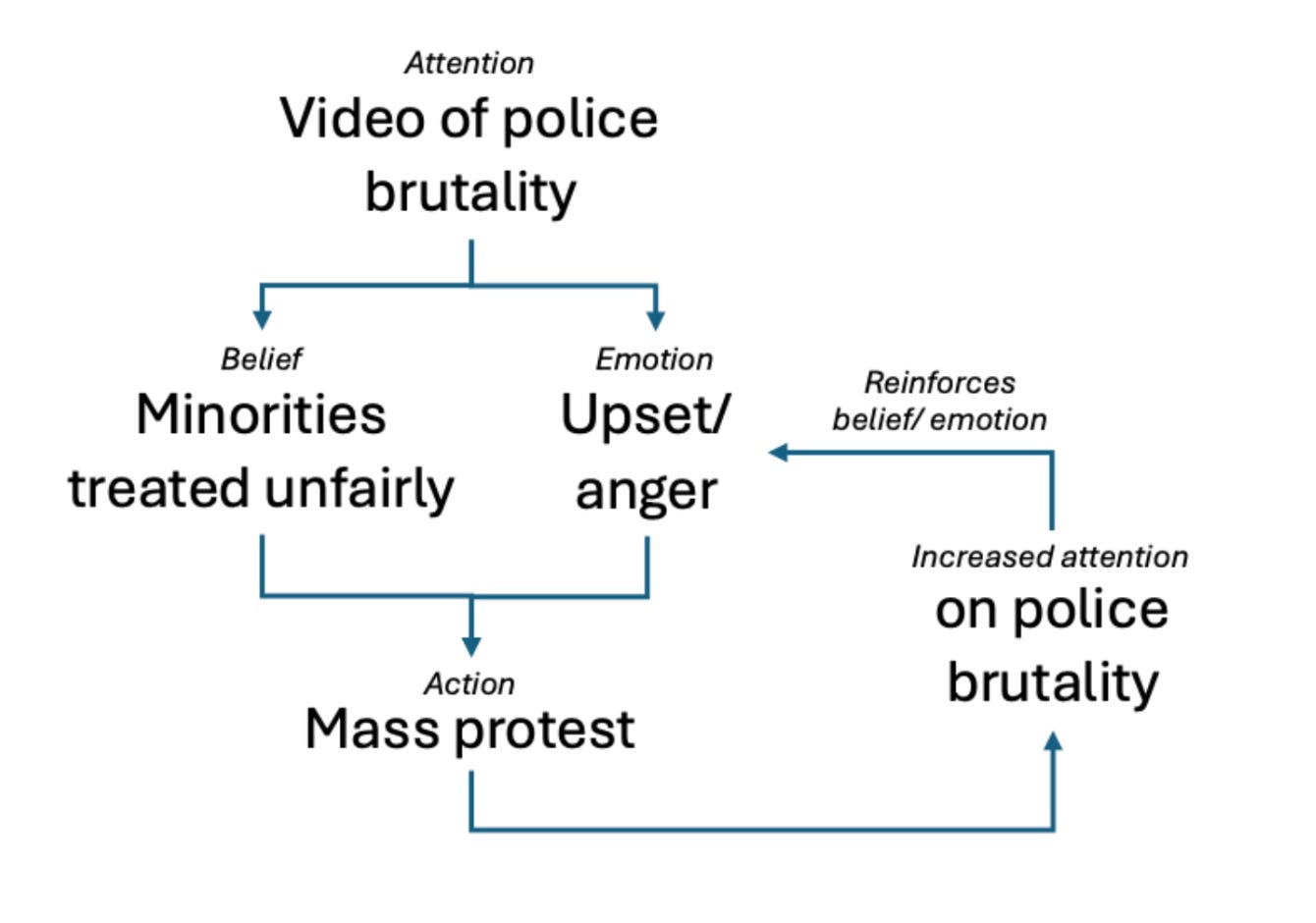
In the business world, this feedback loop can lead to viral marketing effects, where initial attention to a product or brand snowballs into widespread recognition and engagement.
In all, if you can optimally capture attention, alongside driving belief and emotion, you can drive action, which lets you truly shape the world.
For businesses, this translates to the ability to shape consumer behaviour, market trends, and ultimately, the success of your products or services.

How attention is currently distributed
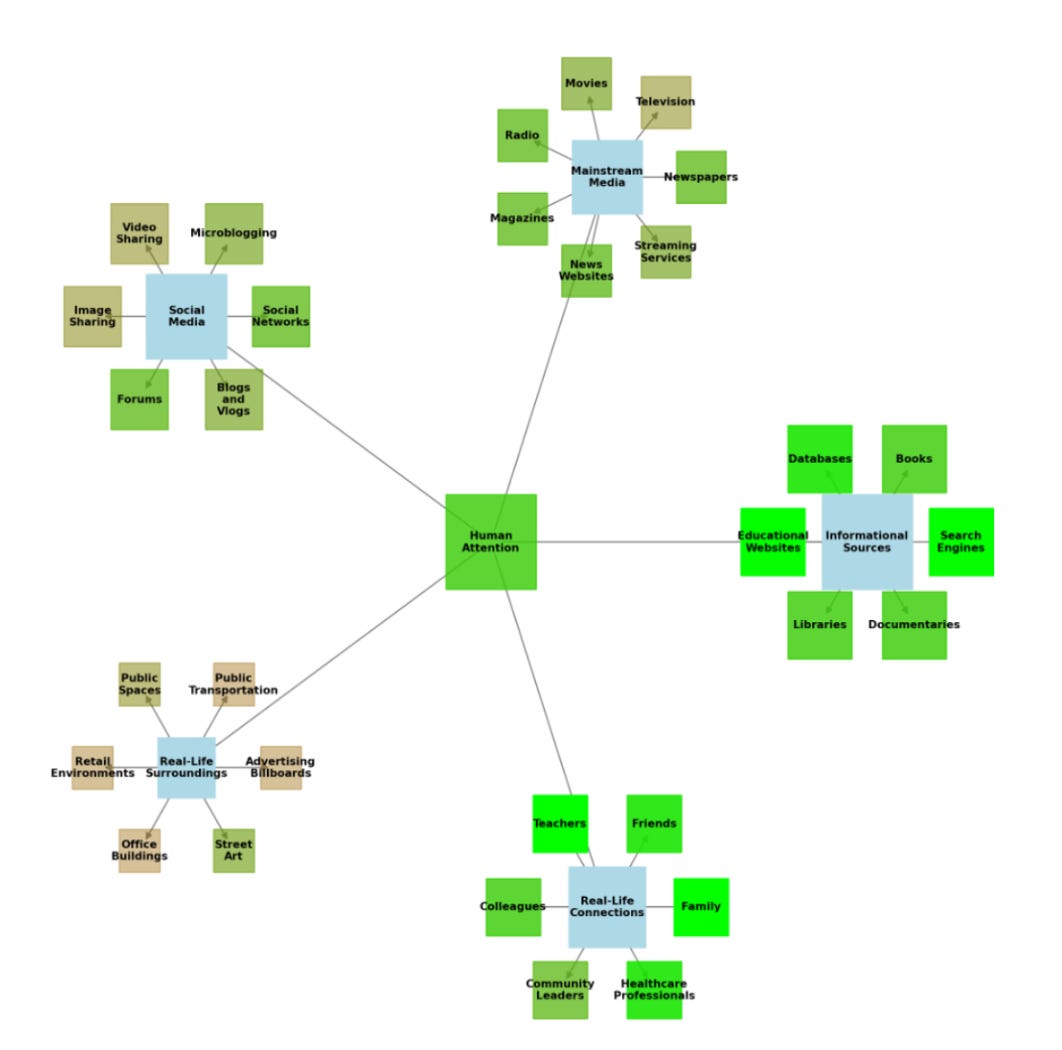
Human attention is a finite resource, directed towards various stimuli, including both natural and artificial content. Natural content includes the outdoors and real-life conversations, while artificial content refers to media like TV, books, or social apps.
Understanding Attentional Value
The selection of content that humans give attention to is driven primarily by what has the highest attentional value.
Attentional value is a measure of a stimulus’s ability to capture and retain human attention. It’s determined by a complex interplay of factors:
Content interestingness: How engaging or novel the information is. Unique, surprising, or highly relevant content tends to have higher attentional value.
Emotional salience: The stimulus’s ability to evoke emotions. Content that triggers strong emotional responses, whether positive or negative, tends to capture attention more effectively.
Environmental relevance: How pertinent the content is to the individual’s current context or needs. Information that helps solve immediate problems or satisfies current curiosities has a higher attentional value.
Cognitive biases: Innate mental shortcuts that influence perception and decision-making. For example, the negativity bias means we often pay more attention to negative information.
These factors work in concert, often subconsciously, to determine which stimuli we prioritise in our personal attention economy. For instance, a breaking news alert about a local emergency would likely have high attentional value due to its novelty, emotional impact, immediate relevance, and innate bias towards potential threats.
For businesses, understanding these factors is crucial for creating marketing content that effectively captures and retains consumer attention in an increasingly crowded digital landscape.
As we’ll explore, the evolution of media has been largely driven by the pursuit of higher attentional value through increasingly sophisticated methods of content delivery and personalisation.
Evolution of Media Personalisation
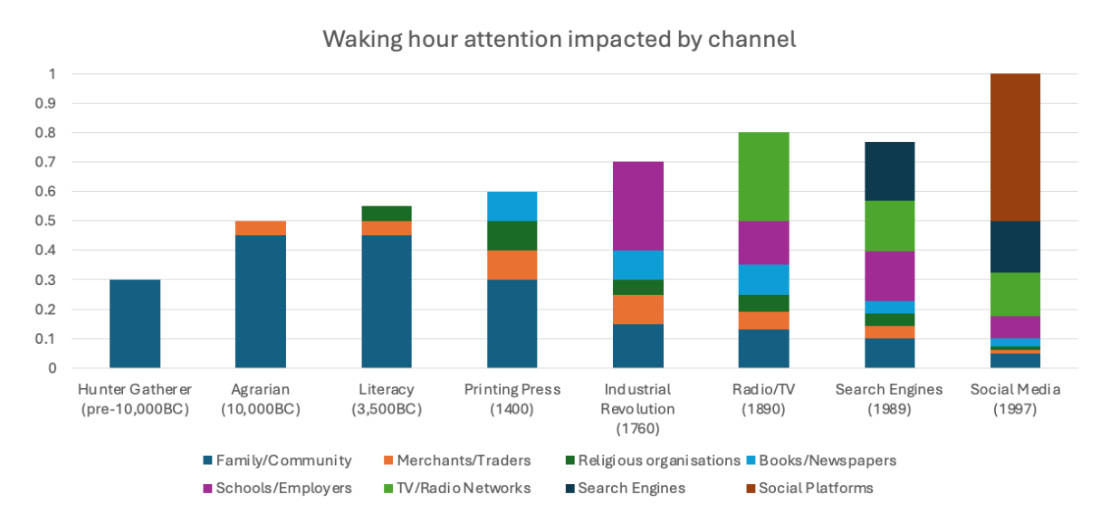
Throughout history, each new content medium has evolved to provide increasing attentional value, primarily through increasing personalisation. Religious manuscripts offered uniform text for all readers. Newspapers introduced variety through different sections and regional editions. Radio and TV further expanded this, enabling content to be tailored to specific time slots and channels. However, the leap to social media represented a quantum shift in this capability.
This evolution mirrors the progression of marketing strategies, from mass marketing to targeted advertising, and now to hyper-personalised campaigns.
Social Media’s Dominance in Attention Capture
Social media platforms achieved dominance in attention capture by serving up content with a higher attentional value for a specific individual at a particular time than other mediums. Social platforms have three key advantages:
Solo user access: Individuals log in to the platforms as solo users so they are watching content specific to what only they want. Facebook, for instance, curates a unique newsfeed for each of its billions of users.
Mass content access: Rather than commissioning content, users and creators upload it online for free. For example, YouTube hosts billions of hours of user-generated videos, most of which can be served to any other user at any time.
User data and processing: Platforms collate data on user viewing preferences and can optimally assess incoming content to show to relevant users at the right time. TikTok’s algorithm, for example, quickly learns user preferences to serve highly engaging content.
For businesses, social media platforms have become indispensable marketing channels, offering unprecedented access to targeted audiences and real-time engagement metrics.
In doing so, social platforms have begun to dominate attention capture. This power has become even more concentrated with the recent shift from social graphs to interest graphs. While the social graph connects users based on social relationships, the interest graph maps users’ preferences and behaviours, allowing for even more precise content targeting. In turn, this has led to a substantial concentration in the powers that social platforms have through the levels of attentional value they drive and the influence they possess.
In 2024, Generative AI (GenAI) represents an even more substantial step change. GenAI can create personalised content in real-time, potentially allowing for the ultimate in tailored content delivery and maximising attentional value.
GenAI - The Final Stepchange in Attention Capture and Persuasion Capabilities
We are currently at a point where people are served optimal content within today’s content production, editing, time, and capability restraints. GenAI removes these restraints, enabling everyone to receive the most optimised content, for the relevant platform, at the right time.
After this, the only methods for improvement will be leveraging more intrusive mediums, which is why GenAI is the final step-change.
For businesses, GenAI represents a paradigm shift in persuasion capabilities, offering unprecedented opportunities for personalisation and engagement.
GenAI enables this through:
Instant, low-cost content generation: taking platforms from having mass content access to infinite content access
Better multimodal understanding of content (i.e., machines understand what’s happening in a video): enabling the algorithms and content creators to substantially improve their knowledge of what content is most effective in reaching and persuading audiences.
Let’s break them down one by one.
1. Instant and Low-Cost Content Generation:
The major benefits that GenAI provides are the ability to produce content:
i) Instantly
ii) at a far lower cost
Instant low-cost content generation enables: i) Entirely personalised content en masse and ii) Far more testing of content than ever before
Combined, this lets us increase the size of the data sets used to see what content works for whom. We can test variables en masse including:
Characters in a video
Exact messages used
Tone of message
Backgrounds
Associations
Placements
There are hundreds of content variables that will be experimented on to find optimal creative sets across different channels for specific customers. The variables will also be dynamic and responsive to external factors as they come up. More importantly, the data collected from testing these variables on different participants enables a better understanding of which messages work for specific individuals.
For marketers, this means the ability to create and test countless variations of ads, emails, social media posts, and other content, optimising for maximum engagement and conversion.
2. Better Machine Understanding of Content
Lately, AI capabilities have improved substantially, allowing for much-improved content analysis with far more data points picked up when analysing video content. By understanding not just the spoken words but also the visual content, on-screen text, and audio cues, AI improvements now bring us closer to assessing what works best on whom, and hopefully, why. This, in turn, will allow intermediaries to recommend optimal content to people, making these platforms and the content shown on them even more engaging.
This advanced content understanding allows businesses to gain deeper insights into consumer preferences and behaviours, enabling more effective targeting and personalisation.
Combining the Two
With instant content generation and multimodal understanding, you can determine what content and messages work across the right combination of channels for specific individuals - substantially improving attribution.
For businesses, this combination offers the potential for truly personalised marketing at scale, with each customer receiving uniquely tailored content across multiple touchpoints.
New Content Mediums
GenAI has also created new mediums, enabling additional opportunities for enhanced persuasion as they become more intertwined in our daily lives.
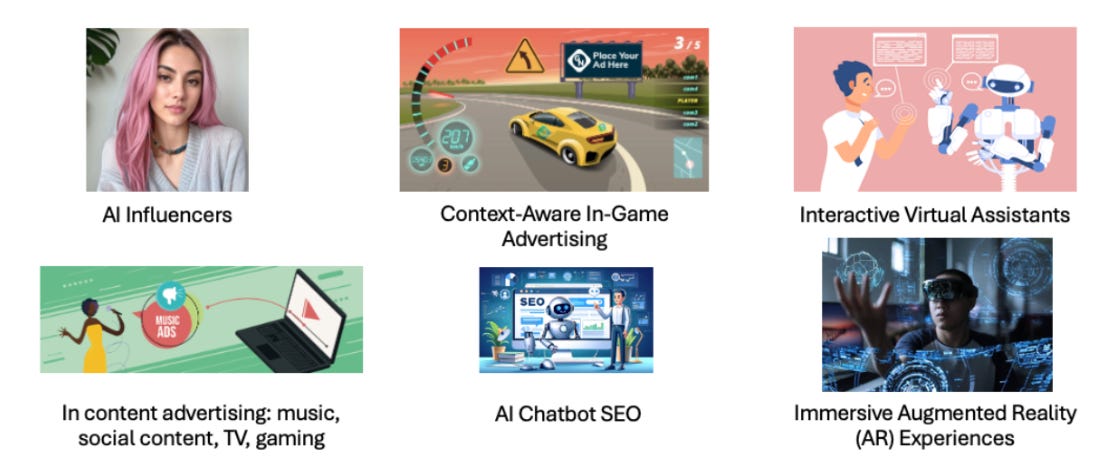
Over time, the number of mediums will continue to evolve, but the hyper-personalised content will feed into those systems, making GenAI the final step change. The winning systems will leverage AI to enhance their creative process, preventing creative fatigue across relevant channels.
Why this matters for companies
At each stage of new technology development, persuasion methods have become increasingly effective, as targeting and messaging have improved materially. Newspapers had localised targeting, TV and radio enabled interest based targeting, and social media now allows for targeting based initially on a social graph and now even more precisely based on a precise interest graph.
During that phase, content has become more specific to specific audiences, and become more personalised. Attribution also substantially improved over prior methods.
We’re about to enter an era of unprecedented persuasion capability as machines develop the ability to hyper-personalise content and substantially improve their understanding of what works to persuade whom across the multitude of increasingly invasive channels.
As GenAI enables the final phase of personalisation, and increased testing improves attribution, those who fail to step up to new mediums, will fall behind in an ever-competitive battle for distribution.
Attention is a finite resource and a relatively zero-sum game. Most companies compete on the same channels, and by leveraging Gen AI, they will gain a substantial competitive advantage through being able to provide more personalised content to consumers, but also better understand what is most likely to work on whom as they can ramp up the rate of testing and understanding why certain content works.
Instant content production and understanding capabilities are improving every day. Those who embrace it will gain the same or a greater advantage than those who embraced social media or the internet when it first came out. Those who don’t will be playing catch-up.